
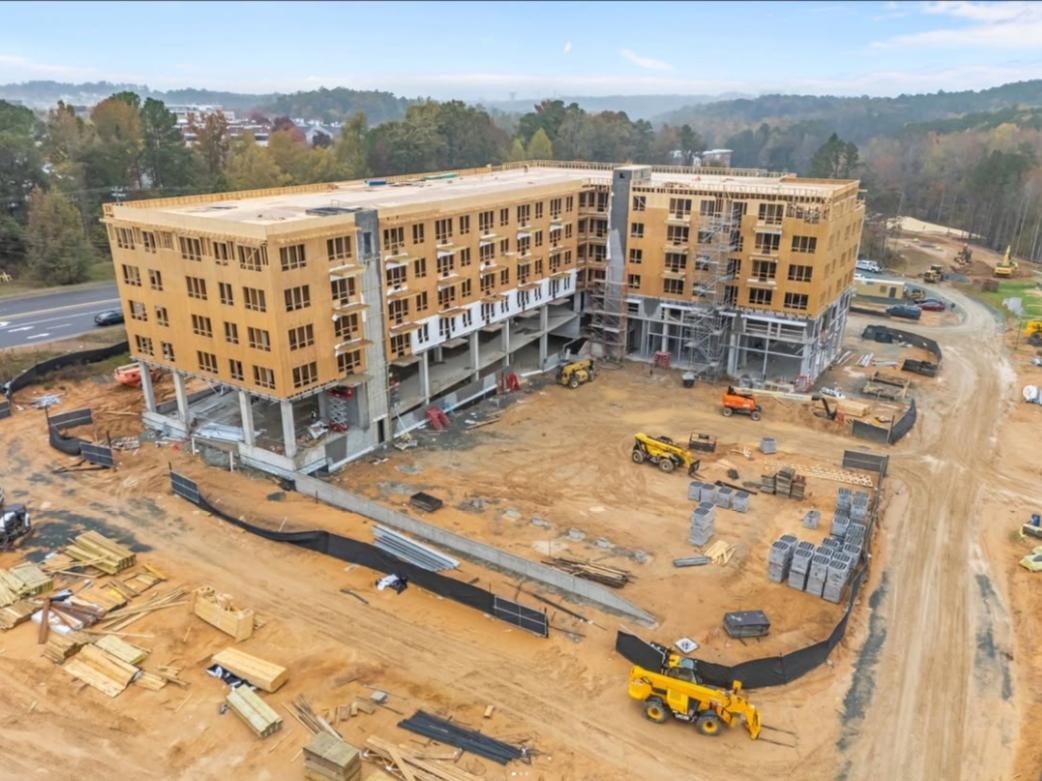
TLDR: The Chapel Hill Carrboro City Schools Board of Education is making school closure decisions based on a student population that steadily shrank during the early- and mid-2020s, a period in which the town built very few new homes. But a housing boom is just starting in Chapel Hill, and the expected influx of residents and their children has not been fully incorporated into the Board’s thinking. It is not at all clear that the closures will be needed.
In 2015, the American Legion was considering selling its post, a 36-acre site near Eastgate Shopping Center, to a developer who was planning to build 600 homes. That same year, Pam Hemminger defeated the incumbent mayor Mark Kleinschmidt with the backing of the Chapel Hill Alliance for a Livable Town (CHALT), an anti-development group whose leaders had long been powerful players in local politics.
In 2016, CHALT successfully pushed for the town to purchase the Legion site for $7.9 million using recently approved bond money to ensure that housing would not be built on the property. For the next seven years the land sat fallow. In May 2022, council member Michael Parker, with the backing of his newly elected pro-housing colleagues, petitioned the town to consider building housing on the site again. After a long fight, with members of CHALT leading the anti-housing side, the council voted 8-1 that December to reserve part of the land for affordable housing, and part for a park.
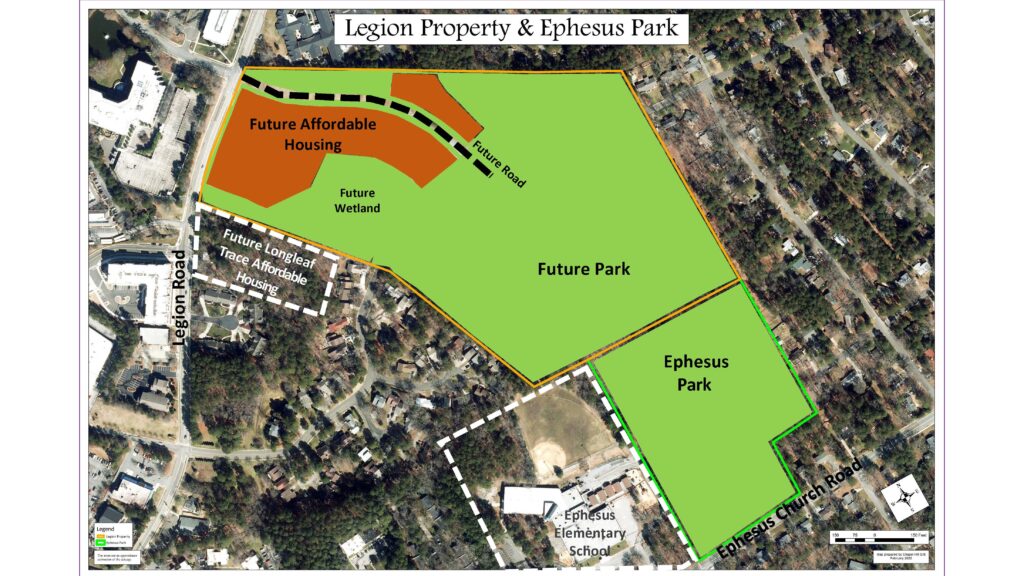
In a few years, 160 affordable rental homes, including some suitable for families, will be built on the property, funded using a mix of federal and local dollars. But meanwhile, the CHCCS Board is considering closing the school nearby, Ephesus Elementary, due to low enrollment in our elementary schools. A community letter opposing the closure appeared last week in the town’s inbox. One of the signatories was former mayor Pam Hemminger, who left office in 2023, but can count as one of her legacies successfully blocking housing from being built on the Legion site.
Over time, Hemminger and several of her colleagues, including current mayor Jess Anderson, changed their minds on housing, supporting not just housing on the Legion site, but in many other parts of town as well. This will soon pay dividends in new housing for families, and, with it, a likely increase in the school-age population that is difficult to model demographically. (Demographers can’t easily account for municipal-level political changes that had restricted growth from happening in our town, especially in comparison to neighboring communities that supported more housing).
We can’t keep our schools from closing if we refuse to build new housing
The housing crash of 2008, and the election of an anti-development council majority in 2015, combined meant that Chapel Hill built very little housing in the 2010s. New housing, of any kind, is valuable because it sets off what researchers call “moving chains.” It works like this:
- Household A are empty nesters, eager to downsize. They sell their 4BR home for $800K and buy a new townhome that better suits their needs.
- Household B are high-income individuals with elementary-age children. They buy home A, and move out of their 2BR starter home, which they sell for $450K.
- Household C are middle-income renters with a toddler. They’ve been living in the same cheap 2BR apartment for five years, sometimes with roommates, and are finally in a position to buy their first home. They purchase home B.
- The landlord of apartment C now has to put their apartment on the market. But because there’s so many other apartments available now, they can’t raise the rent. Households D, E, F, and G all benefit.
These moving chains can work pretty quickly, as people tend to prefer new housing if it’s available. And, if we don’t build enough housing, the reverse happens, with well-off people paying a premium to buy what was inexpensive housing. The scarcity of housing raises rents, and a surplus of housing lowers them.
Chapel Hill is quickly moving from scarcity to supply
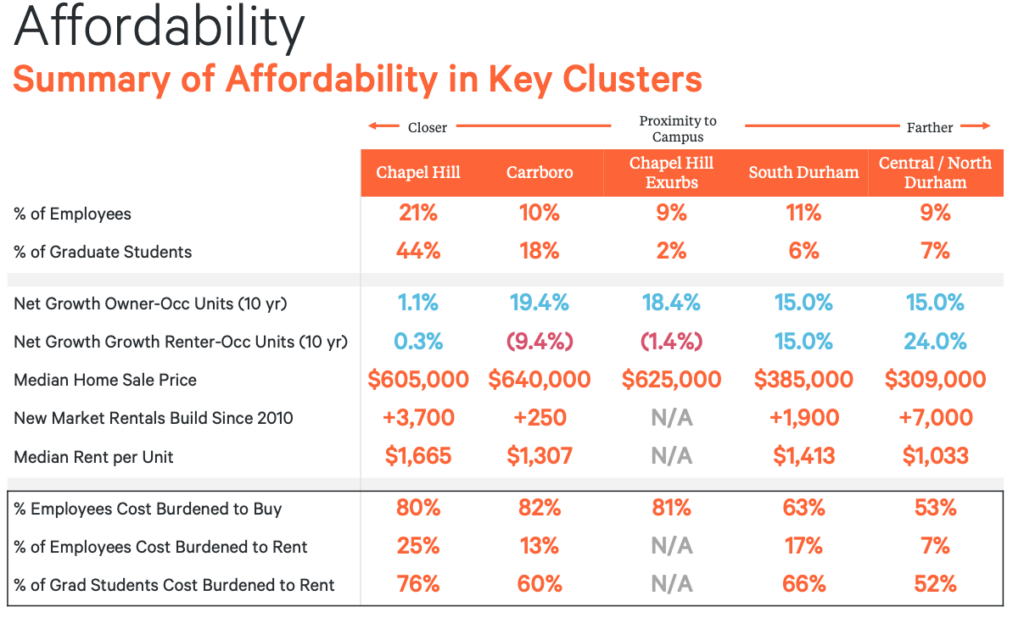
In retrospect, 2021 will be seen as a key year in Chapel Hill housing politics. That year, the consultant Rod Stevens issued a housing study which argued that Chapel Hill needs to build ~500 homes/year, or risk being Palo Alto, a place where the average home, often a modest mid-century ranch, sells for $3.5M, making it unaffordable for anyone except people with inherited wealth and fancy tech jobs.
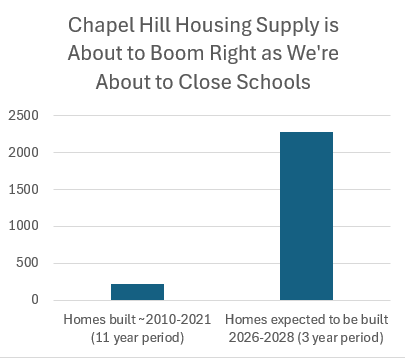
At the time the study was released, Chapel Hill was growing anemically, adding just one percent of its housing stock between 2010 and 2021. While a few very visible rental projects, like the Berkshire next to Whole Foods, made it seem like our town was growing, teardowns in our neighborhoods, where duplexes were turned into McMansions, and the loss of older apartment buildings, meant that we were falling behind.
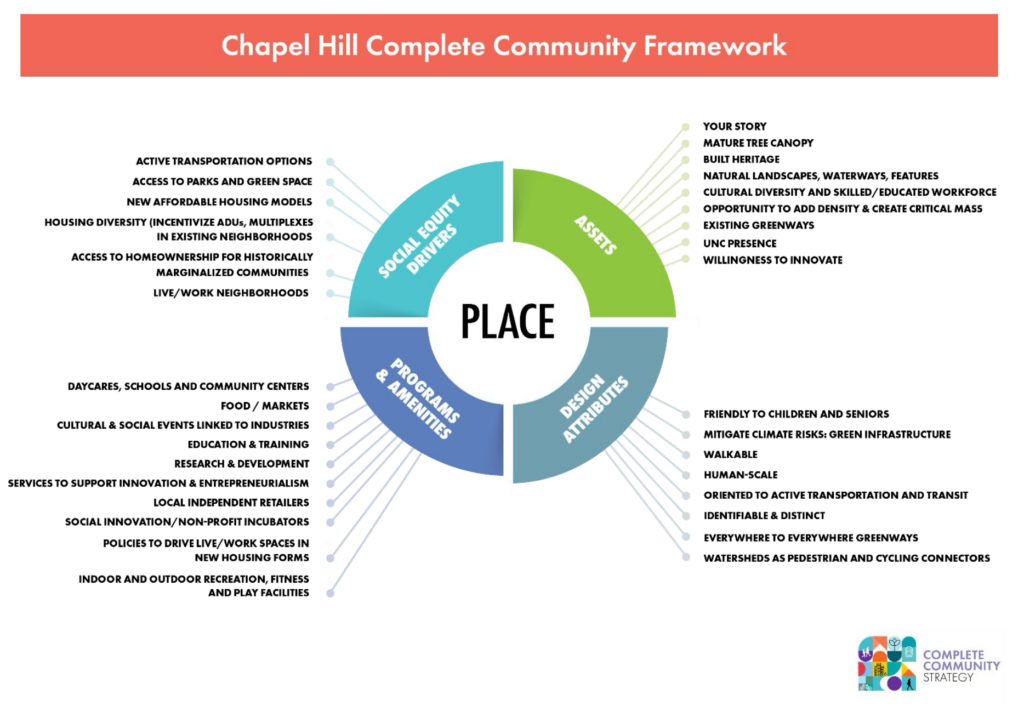
But starting in 2021, things began to change. In June, a few months before the housing study was released, Jess Anderson, then a council member, courageously voted in favor of Aura Booth Park, on the corner of Estes and MLK, over CHALT opposition. In 2022, the town adopted a Complete Community strategy, which encourages us to add housing while building greenways and protecting the environment. Because it takes years for a project to go from council approval to permitting to construction to actually opening, Aura is just now starting to welcome new residents.
Political changes in both Chapel Hill and Carrboro have meant that we’ve moved from a politics of scarcity—where the main goal of many elected officials was to limit or stop development—to one of supply, where our leaders are looking to make it easier to build housing in our communities, at all price points and for all kinds of people.
Another key finding of the housing study was the need to build housing for all, not just apartments appropriate for students, which still helps, but limits the effect of moving chains. Unlike the developments built in the late 2010s and early 2020s, the 419 homes in Booth Park include 3 and 4 BR apartments and townhomes, all housing suitable for families with children.
New homes are being built all over town
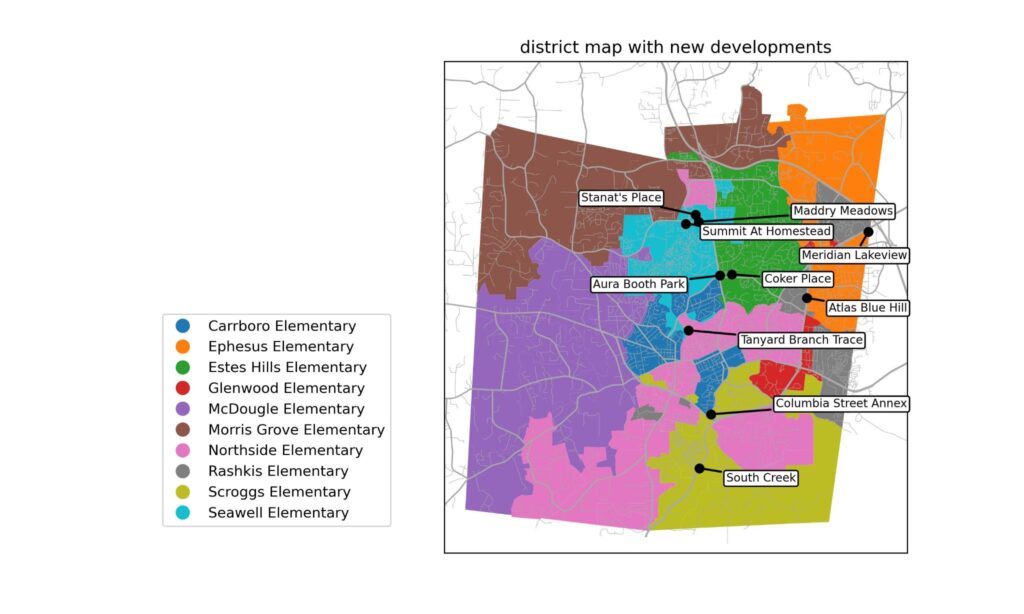
Aura Booth Park alone is adding more homes to Chapel Hill than were built in the previous decade. Next door, another project, Coker Place, is adding 40 townhomes and almost 70 condominiums, which means that Estes Hills Elementary will soon have more than 500 homes within a short walk of its doors. While the nearby suburban neighborhoods use up a lot of land, with each home taking up a third-acre or more, the new housing is much more compact, with each home taking only one-twentieth of an acre.
Current Estes Hills enrollment is 324, and the Carolina Demography analysis, which didn’t take new housing into account, projected that 2030 enrollment would be 359. However, if just one-fifth of the households in Aura Booth Park and Coker Place have elementary age children, we’ll see an additional 100 children at the school. Given that the primary advantage of living in that location is proximity to an elementary and middle school, we would not be surprised if that number is higher.
And Aura Booth Park and Coker Place are far from the only developments that are adding new housing. We are on track to build almost 2,300 new homes, which would be a 10 percent increase in the number of homes in Chapel Hill, in the next three years. Here’s our estimates:
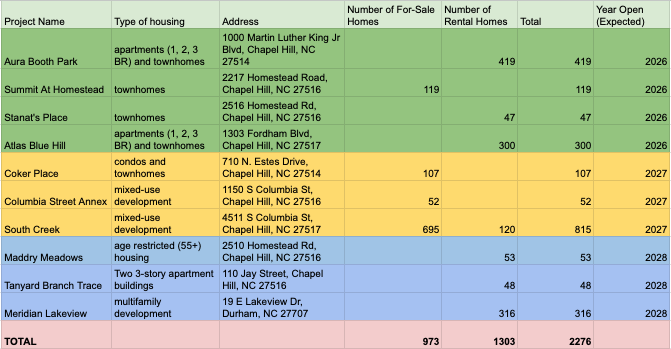
The last time we built more than a thousand homes in Chapel Hill in a few years, we built an elementary school (Rashkis, part of Meadowmont, which has more than 1,100 homes). In fact, over the next three years we are building the equivalent of Meadowmont (1,100 homes) and Southern Village (1,200 homes) combined. Instead of building two new schools, as we did then, the CHCCS Board is considering closing two schools. And the number above only includes housing in the CHCCS school district. The Chapel Hill council has also approved additional housing just over the Durham border, which will benefit our tax base and, thanks to moving chains, likely lead to a little more housing available for people who prefer to send their kids to CHCCS. And, we didn’t count any new housing in Carrboro, which, though smaller, also has the land to add a lot more housing.
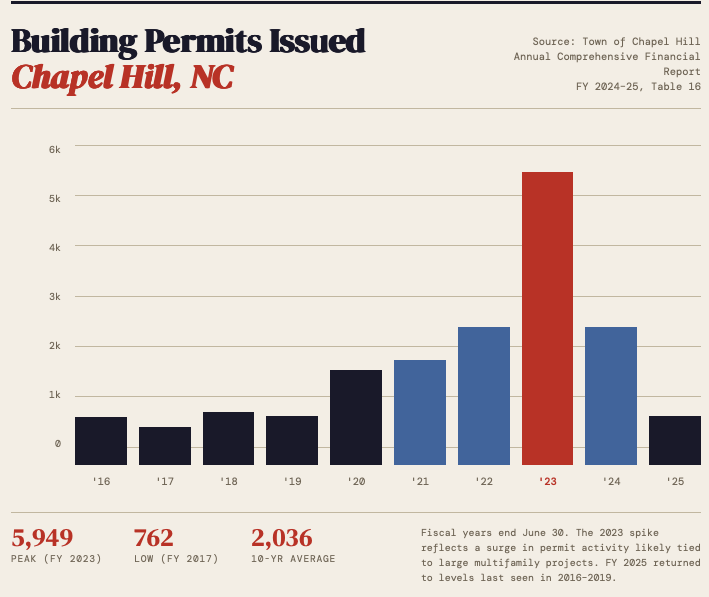
We can see signs of this growth in the Chapel Hill’s permitting data as well, with the number of building permits dramatically increasing in 2023 over previous levels. While permitting slowed in 2025, policy changes are encouraging more people to consider building homes in our community again, which will help unlock more housing in our neighborhoods. (Obviously, you get a permit before starting construction, so the 2023 spike is what’s allowing all the current housing to be built.).
And more housing might be coming
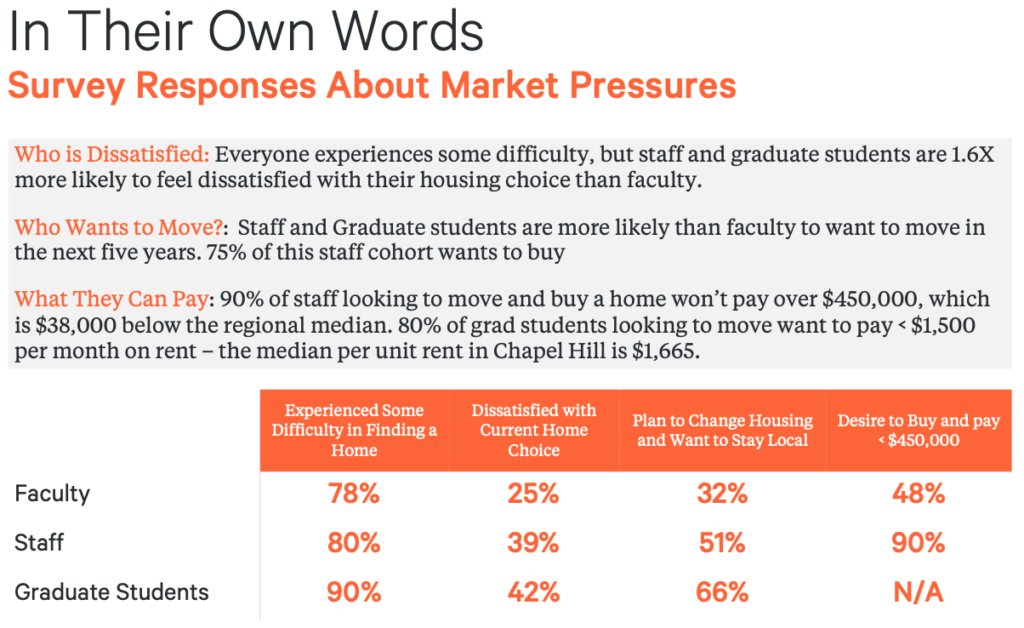
And, this analysis doesn’t consider UNC’s planned development at Carolina North, which is set to commence soon. If UNC builds housing for faculty and staff there, as they say they plan to do, we could see even more children in our district who would otherwise be living in Pittsboro, Apex, or Durham. UNC’s own housing study found that many employees would prefer to live in Chapel Hill if housing was available. We’re also not counting projects that are approved, but are likely a few years away from breaking ground. Just last night, the Chapel Hill Town Council voted 8-1 to approve 860 Weaver Dairy, which will add up to 735 homes between Carol Woods and Harris Teeter in northern Chapel Hill.
Our housing growth is catching up. We have a ways to go.
A healthy community should be adding housing at a regular clip, more when the market is hot, less when it cools down. But, the presence of anti-growth advocates in Chapel Hill for forty years meant that even though our region was growing quickly, Chapel Hill and Carrboro were not. When the Triangle got its name, Chapel Hill was one of the three points. Now, because we’ve failed to keep up, Chapel Hill is just the fifth largest city in the region, with Raleigh, Durham, Cary, and even Apex ahead of us. (Wake Forest and Holly Springs aren’t far behind). Our lack of housing has meant that we’ve lost our dynamism and openness, qualities that we were once known for.
For a community that has never closed a school due to population loss, this is a pivotal moment. We’re building homes. Let’s build some more, support CHCCS in doing what it takes to win back students, and keep as many of our schools open as we can.
Q&A
Question: Are we really losing students because housing is expensive?
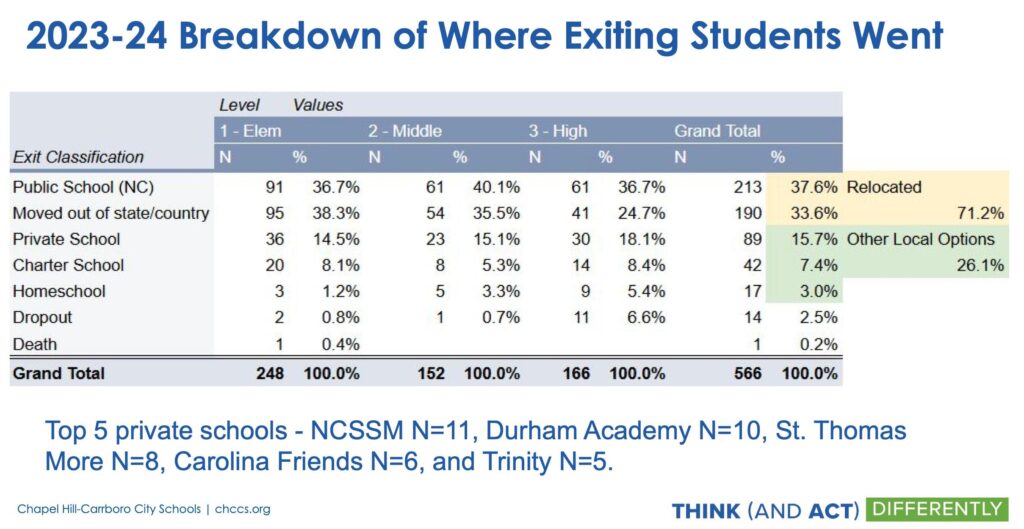
Answer: We can’t be sure, but the CHCCS’s own data notes that a third of students left the district in 2023-2024 because they moved elsewhere in NC. We suspect that some of the people who moved did so in search of more affordable housing. While private and charter schools are a factor in enrollment declines, they are not the dominant ones. And, of course, families cannot move to the district in the first place if there’s not an adequate supply of housing.
Question: Did Chapel Hill really grow its housing by just one percent in the 2010s?
Answer: Yes. UNC and the town have conducted multiple studies, each finding the same thing. Remember, this is a net number, so if a property owner tore down an old apartment building in the 2010s, but didn’t replace it until the 2020s, it would lower the net number in the 2010s, but raise it in the 2020s. When the council learned this in 2021, they were equally surprised, but over time careful analysis has shown that this number is correct. (You can check the census yourself).
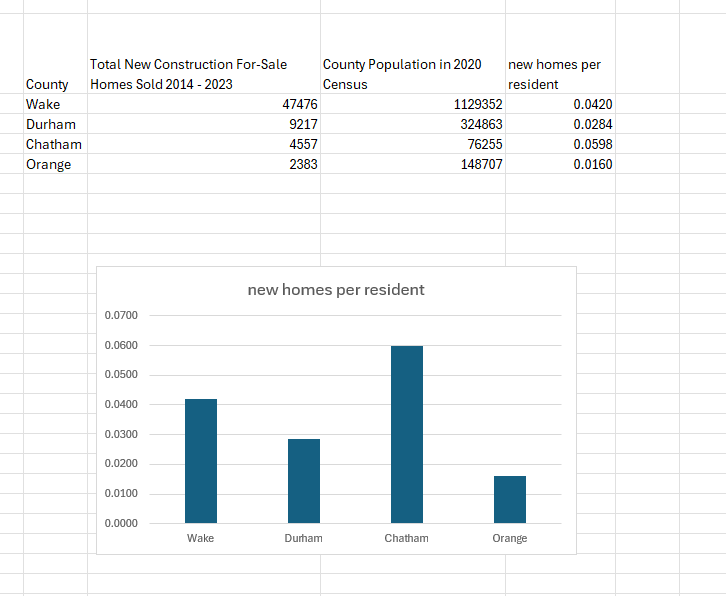
Another way to think about this is to compare Orange County’s production of for-sale housing, which is particularly attractive for people who want their kids to be in a particular school district, with neighboring counties, which have added much more housing in recent years. And remember that other parts of Orange County, like Hillsborough and Mebane, added a lot more housing than Chapel Hill and Carrboro did in this period.
Question: How can we be sure that we really will add 2,276 homes in the next three years?
Answer: In the above chart, most of the projects listed for 2026 and 2027 have already gone vertical, as they say in the construction business. In some cases, you can visit the model homes, or even move in to a home that’s newly finished. In others, you can watch the construction happen.
For the projects that are scheduled to open in 2028, it might take a little more time, but at this moment all are scheduled to break ground soon. A 2023 study conducted as part of its plans for bus-rapid transit system along MLK, Jr. Boulevard estimated that Chapel Hill needs an additional 5,785 homes by 2040 to meet demand. Already, tens of thousands of people drive into Chapel Hill to work every day. Building housing so they can live and work in the same place is part of Chapel Hill’s longterm goals.
While there are dangers to counting homes “in the pipeline” too far ahead of time, it would take an unprecedented event to stop projects that are already under construction, like South Creek, or Coker Place, from being built. And those two projects alone, along with ready-to-lease Atlas Blue Hill and Aura Booth Park, count for 1,600 homes, more than Southern Village or Meadowmont. (This will also be good for our school finances, as dense projects like these contribute more to taxes than they cost in services).
Question: How long will it take for people to move into these homes?
Answer: We don’t know, exactly. But we do know that Chapel Hill is a desirable place to live, and we’re in a region that continues to grow. We wouldn’t see this level of development if builders and investors thought it was risky. It might take a few years for these projects to fill, but we anticipate by 2030 these will be fully occupied. The apartment vacancy rate in Chapel Hill remains very low, and UNC last year announced it was adding 500 students a year for the next nine years, which means by 2035 we’ll have an extra 5,000 students living in town. They all need housing too.
Alyson Culin and Chris Esposito contributed to this article.
Chris Esposito is a parent of two current and one future Ephesus Elementary School students. He is a coastal wetlands scientist based in Chapel Hill.
Alyson Culin runs Blue Hill Strategies, a small consultancy focused on effective nonprofit and public agency governance. She is a Triangle native who lives in Chapel Hill with her husband and three children. She is a parent at Ephesus Elementary School and also sits on the Ephesus School Improvement Team.
Martin Johnson has two children in the Chapel Hill Carrboro City Schools.