
Note: We would like to publish a variety of perspectives on school closures. Please submit to triangleblogblog@gmail and include your affiliation if you are a parent or teacher at a particular school.
In the coming weeks, the CHCCS will make one of the hardest decisions a school board has to make—whether and which elementary schools to close due to a decline in enrollment (CHCCS Board members George Griffin and Melinda Manning have recently written on the decision. We encourage other board members to do the same). As expected, the people who have the most invested in this issue are current and future parents of elementary school children attending, or slotted to attend, one of the schools that may be closed. But this conversation should involve our entire community, as our schools are a cornerstone of what makes Chapel Hill and Carrboro distinctive. We think that school closure is a big deal, one that the board should consider using holistic criteria, not just building conditions. Here are seven charts that illustrate just a few things we need to keep in mind.
When it comes to education, North Carolina leads the nation in stinginess
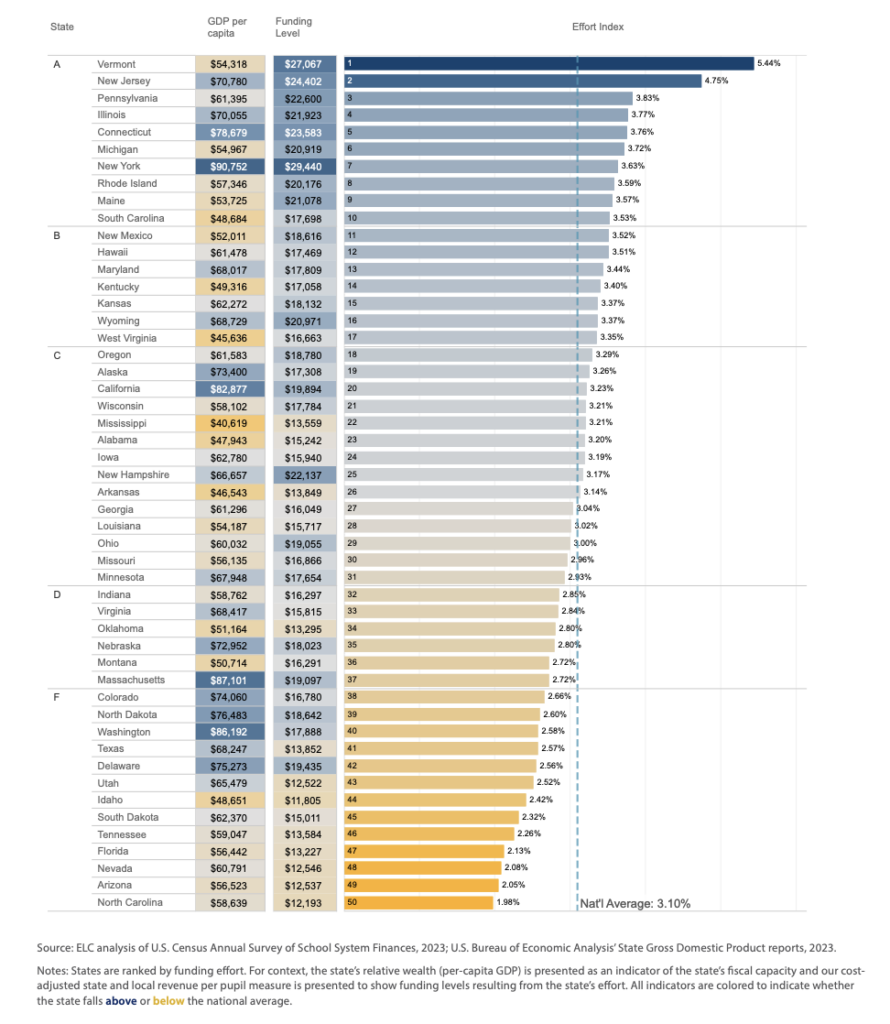
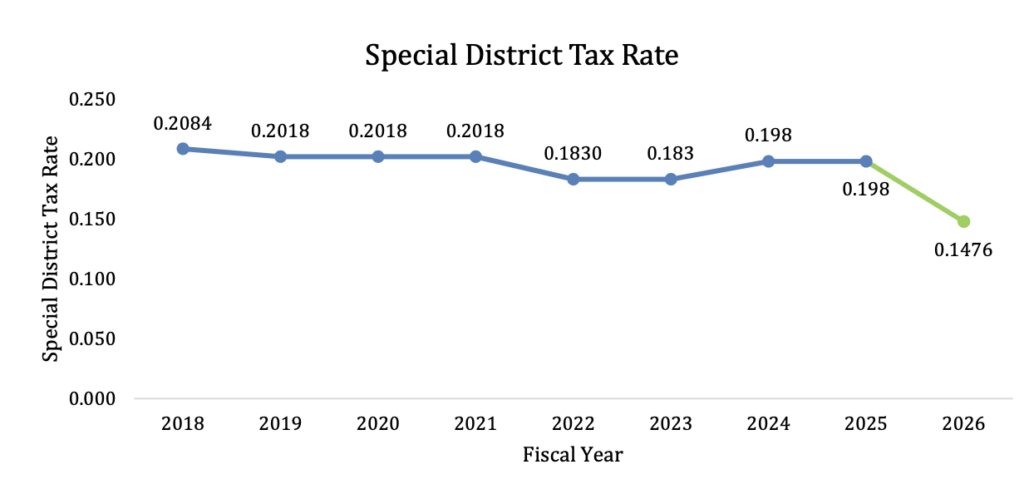
We all know that North Carolina is now last, or close to it, on so many criteria related to school funding. But we’re also last in generosity, a measure the Educational Law Center (which advocates for fair school funding formulas) calculated by comparing a state’s GDP per capita with its per pupil spending. As anyone who’s lived in other states knows, North Carolina’s property taxes are lower than those in other states, many of which spend a lot of local property tax revenue on education. While CHCCS district residents pay a special school tax (about $75/month for someone who owns a median-priced home in our community), there are many communities who pay much more in tax to support their schools. According to the Department of Public Instruction, CHCCS spends $17,256 per pupil, which puts us on par with South Carolina. We can do better.
Our school enrollment is falling, particularly at the elementary level, but kindergarten enrollment is increasing!
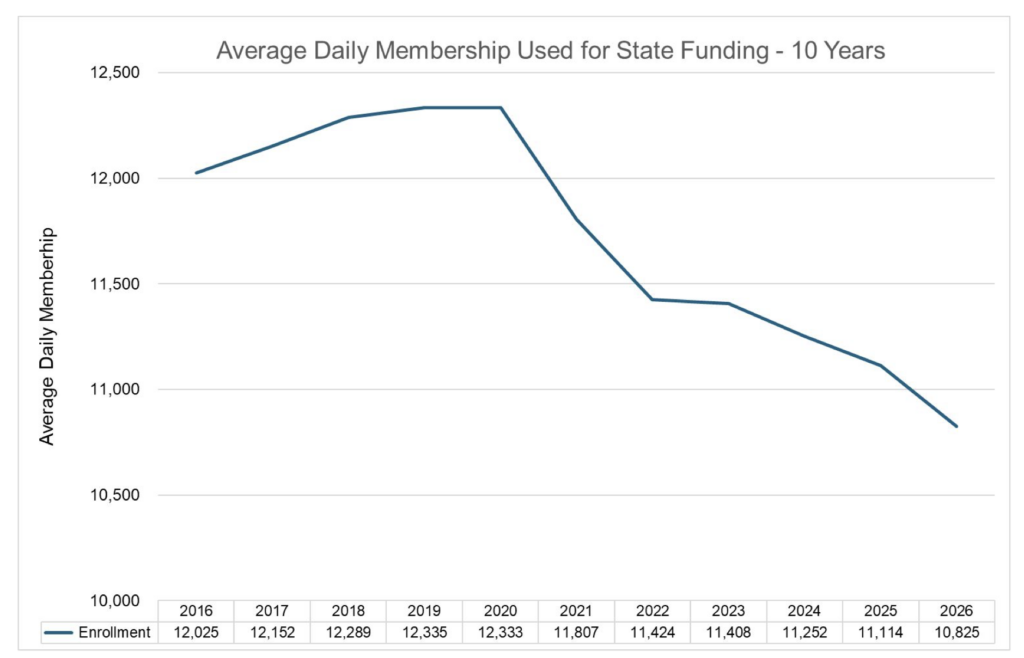
Chapel Hill continues to grow, with almost 2,000 people moving here since 2020, bringing our town’s population to over 64,000. But our school population has declined by over 1,500 students since 2020, part of a trend that is both nationwide and even worse in communities like ours (wealthy, with a history of opposition to new housing).
Much of this decline is coming in the lower grades (K-8), and the drops are larger as you get to kindergarten and first-grade students.
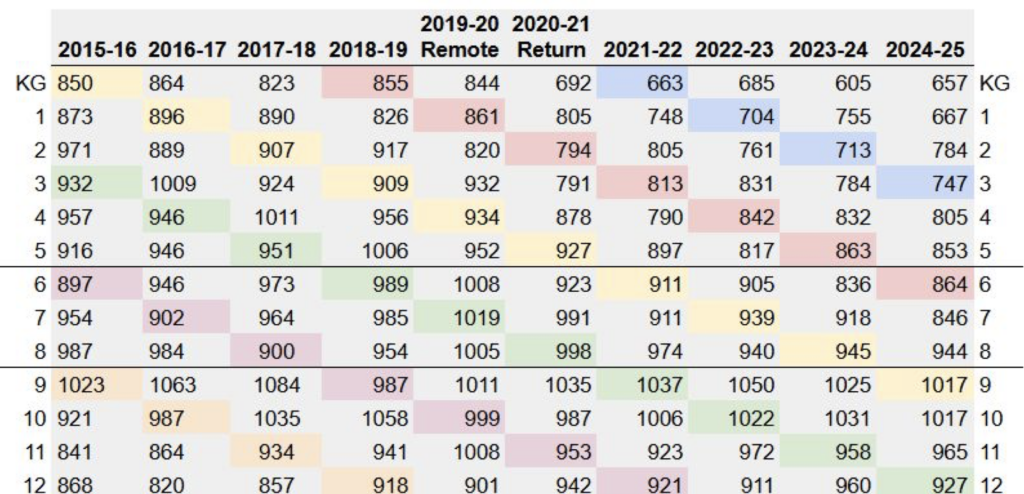
However, if you look closely, you’ll see that the Kindergarten population rose 8 percent for the 2024-2025 year. If that trend continues (and it might), we’ll be in a better place in a few years.
Our elementary enrollments vary a lot by school, and our newest schools have the lowest enrollment
At the CHCCS Board retreat (government speak for an extra long meeting) in December, the Board heard a presentation from Carolina Demography giving them some more granular detail—and a few projections—about the schools. While we wish this data included more accurate projections, accounting for the thousands of homes that are now being built in Chapel Hill, even the 2025 numbers tell us something about trends in the district.
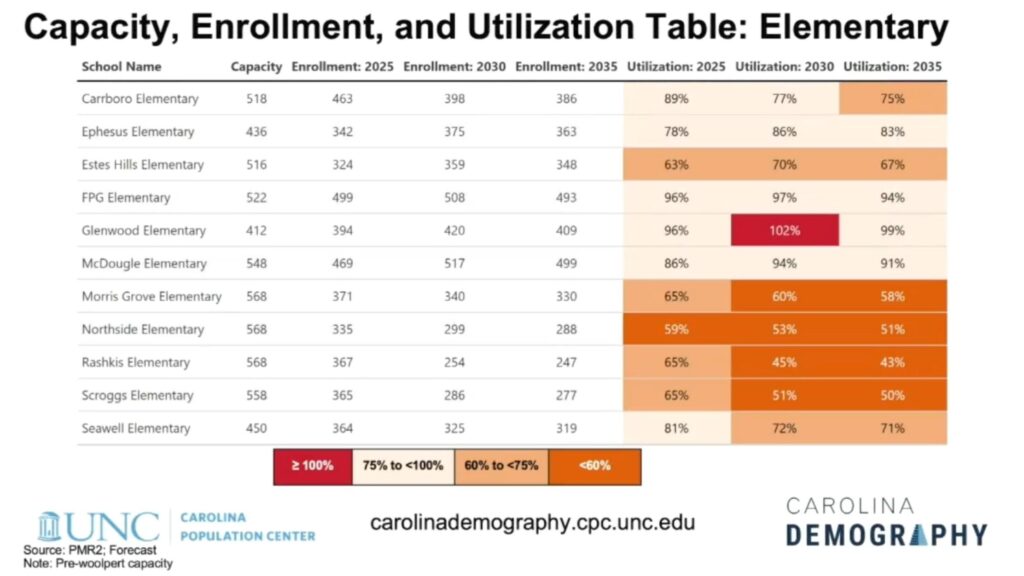
What stands out about this slide is that all of the schools that are projected to have severe enrollment challenges in 2025 and beyond are not the schools under consideration for closure. Instead, they are largely schools on the edge of the district—Morris Grove, Scroggs, and Rashkis—and Northside Elementary. All four are likely suffering due to high housing costs—restrictive zoning in Northside, which makes it difficult to build new house, and large, expensive neighborhoods that are now largely built out that were designed to feed the three other schools— Meadowmont (Rashkis), Southern Village (Scroggs), and Lake Hogan Farms (Morris Grove). While new nearby housing might help those schools win back population, it will take some time. Frustratingly, these four schools are also the four newest schools in the district, and thus have among the lowest facilities needs.
This slide also demonstrates the success of the dual language programs at FPG and Glenwood, which have, and are projected to continue having, the highest utilization scores in the district. While the buildings of Glenwood and FPG may be old, the school communities within them are thriving.
Almost all of the CHCCS school buildings are in bad condition, which makes it harder to decide which ones to repair and which ones to replace
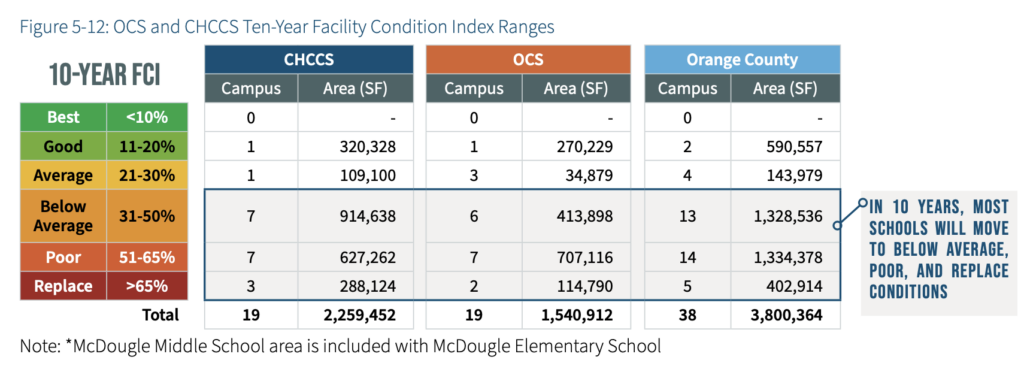
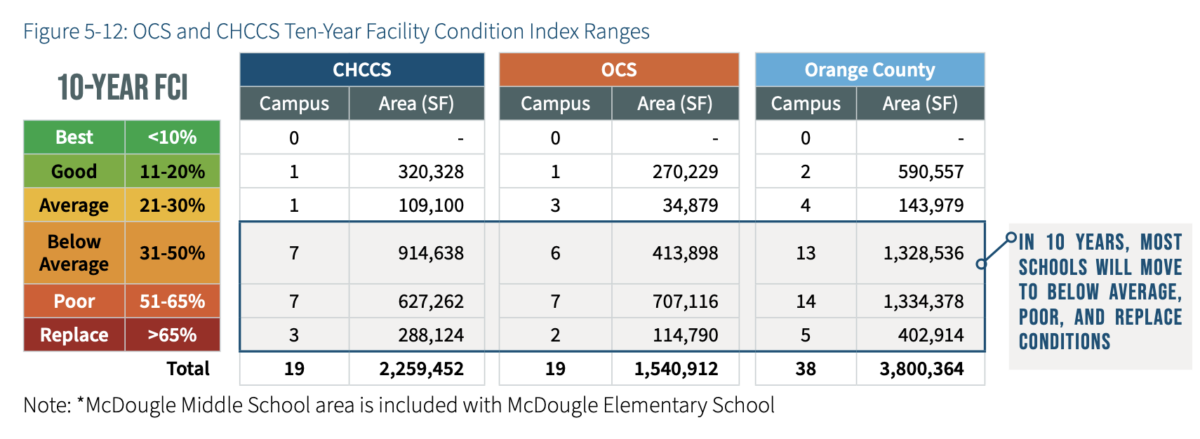
According to the 2023 State of Facilities Report, conducted to assess school building needs in the county, within ten years (so, 2033), three school buildings in the CHCCS district will be failing and in need of replacement—Estes Hill Elementary, Frank Porter Graham Elementary, and Carrboro High. Confusingly, the Long-Term Optimization Plan, also released in 2023, recommends replacing Carrboro Elementary, building a new middle school, and replacing Culbreth and Phillips within a ten-year window. The schools on the replacement list have continued to change since 2023, and the previous CHCCS Board committed to replacing Carrboro Elementary first, with Estes Hills Elementary and Frank Porter Graham Elementary to follow. (As we understand it, the current Board is not legally required to follow the intentions of the previous Board. The 2024 bond language did not commit the district to any specific projects, although the Board last week approved construction for a new Carrboro Elementary).
But, as the 2023 report suggests, within ten years all but two of the schools in the CHCCS system will be below average, suggesting that the repair needs are widespread across the district.
There’s only one school in Chapel Hill where more than 30 percent of students bike or walk to get there
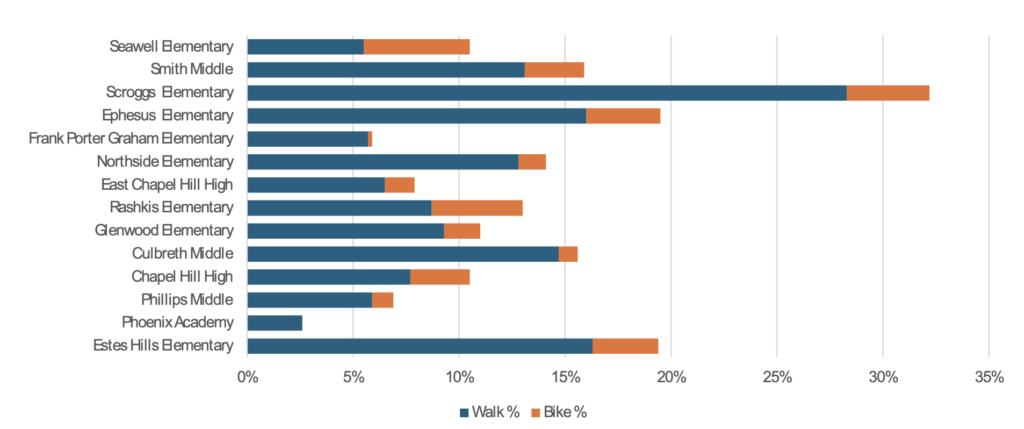
The towns of Chapel Hill and Carrboro are both invested in making our communities safer places to walk and bike. In Chapel Hill, we have a Safe Routes to School program, whose coordinator Alyson West (a friend of the authors) has done fantastic work in collecting data and coming up with an action plan to make it easier for our kids to get to school. While some schools in our district have large walk zones (McDougle, Carrboro, Ephesus) others do not due to their location (Seawell, Morris Grove) or their status as a magnet school (Glenwood, FPG).
According to DPI, CCHCS spends $936 per pupil on busing, Fortunately, only 3,880 pupils take the bus, with the remainder walking, biking, or driving. But, if our district becomes more bus dependent due to redistricting and the absence of bike lanes, we could end up spending a lot more on bus service, which is something our district, as well as our neighbors, struggle to provide. Even a ten-percent uptick in bus riders (388) would cost the district $363,168 annually to provide. A mile of greenway cost $2M, so building infrastructure that reduces the need to have to bus kids would pay for itself within a few years. (Even better, the greenway would likely be paid for out of town and, possibly, federal dollars, while the school system has to provide bus service).