
Note: we would like to publish a variety of perspectives on school closures. Please submit to triangleblogblog@gmail and include your affiliation if you are a parent or teacher at a particular school.
TLDR: Chapel Hill-Carrboro City Schools (CHCCS) is facing aging facilities and a steep decline in the projected population of elementary school students entering the district. The much-discussed Woolpert reports (the 2023 State of Schools Report and Long-Range Facilities Optimization Plan) that the district commissioned in 2023 found that facility maintenance needs across both CHCCS and Orange County Schools would come to about $1 billion. Amidst the deteriorating buildings, the number of incoming Kindergarteners to the Chapel Hill district has been dropping for nearly a decade and is expected to continue to do so for the foreseeable future. The board has decided that at least one and probably two elementary schools must be closed to account for the reduced demand. On March 5, they will decide which criteria to use in making this decision. Using a criteria only focused on facilities is insufficient. The CHCCS board should take a more holistic approach, considering programs, transportation, and housing.
How we got here
From 1999 to 2013, CHCCS opened four new elementary schools, adding to the seven it already had. Two of these were part of large developments (Rashkis and Scroggs), one was built on rural county-owned land (Morris Grove), and one was built near downtown (Northside). These schools, along with a new middle school (Smith, 2006) and a high school (Carrboro, 2007) were built in response to increased demand, one that leaders at the time expected to continue indefinitely. Instead, CHCCS peaked at 12,296 students in the 2018-19 school year, and has experienced a dramatic decline since then. In September, CHCCS reported an enrollment of just 10,823 students. This is the lowest number since 2004, when the school enrolled 10,721 students, and, importantly, had just nine elementary schools, two less than today. Meanwhile, we have five elementary schools that were built before 1972 and are in need of repair or replacement. The enrollment drop has been particularly severe in our elementary schools. In several, our schools are less than seventy percent full.
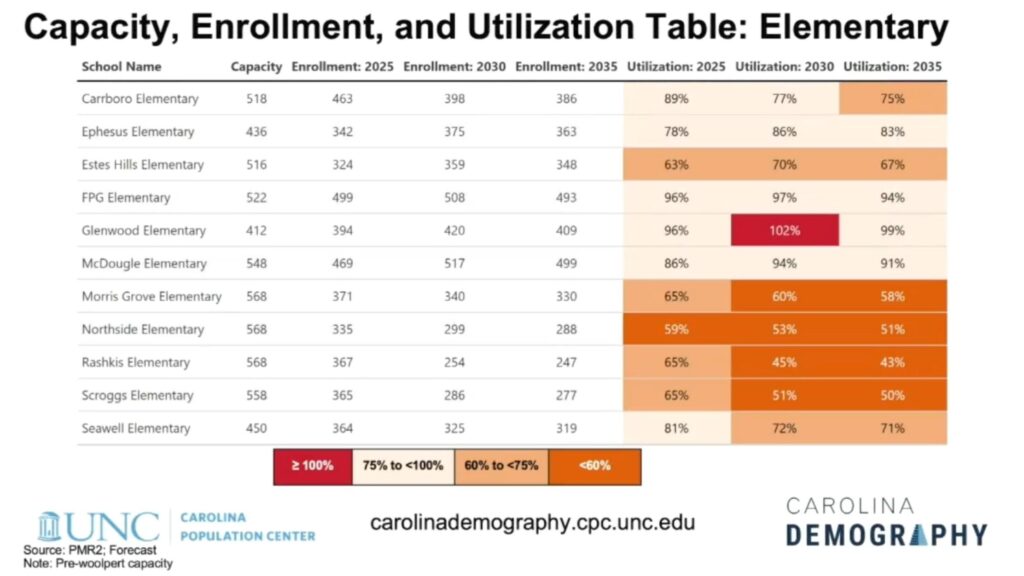
The combination of older buildings with fewer students saddles the Board of Education with the unenviable task of revitalizing facilities while also downsizing them. This is a challenging position that requires careful planning, clear communication, and rigorous adherence to a transparent process that will ensure an equitable distribution of resources and prevent conflict between school communities. And, because of the unexpected drop in enrollment, the CHCCS Board has to act quickly to avoid severe, and sudden, job cuts. (CHCCS receives $7,500 per student per year. Last year’s decline in enrollment will cost the district almost $2M.)
If we need to close schools, how should we decide which schools to close?
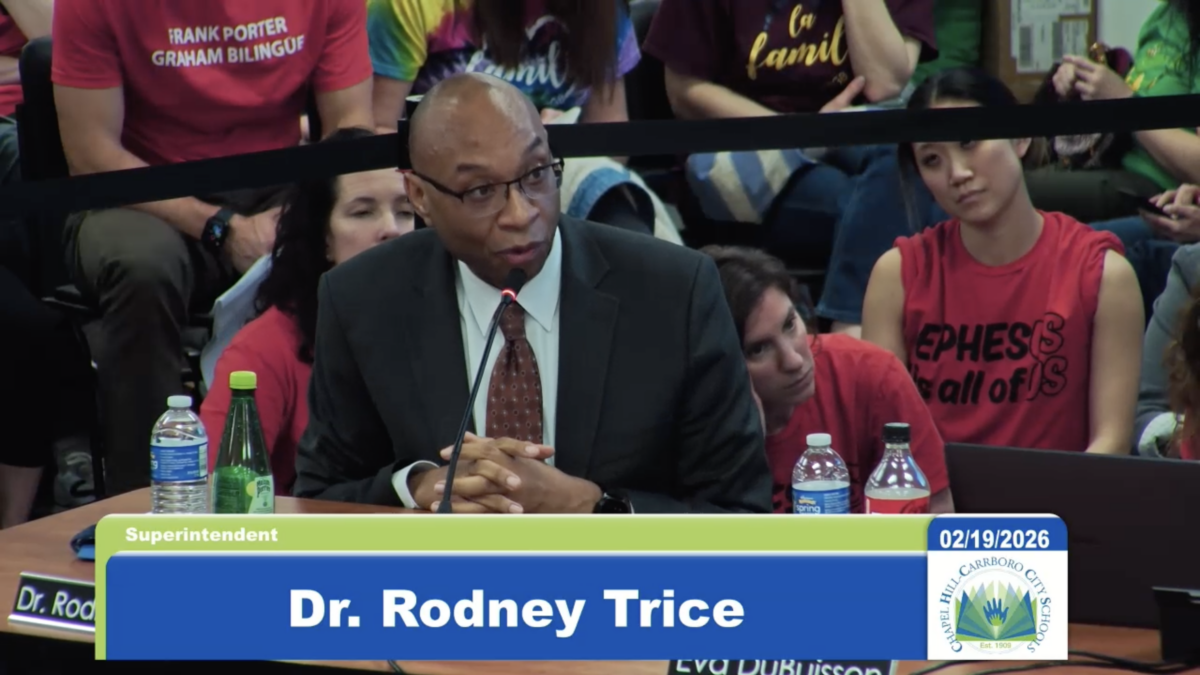
Across its first three public meetings this year (January 15, February 5, and February 19) the CHCCS board has struggled to decide how many schools to close, determine which schools would be candidates to consider for closure, and decide which assessment criteria they would use to guide these decisions. We do not envy their decision.
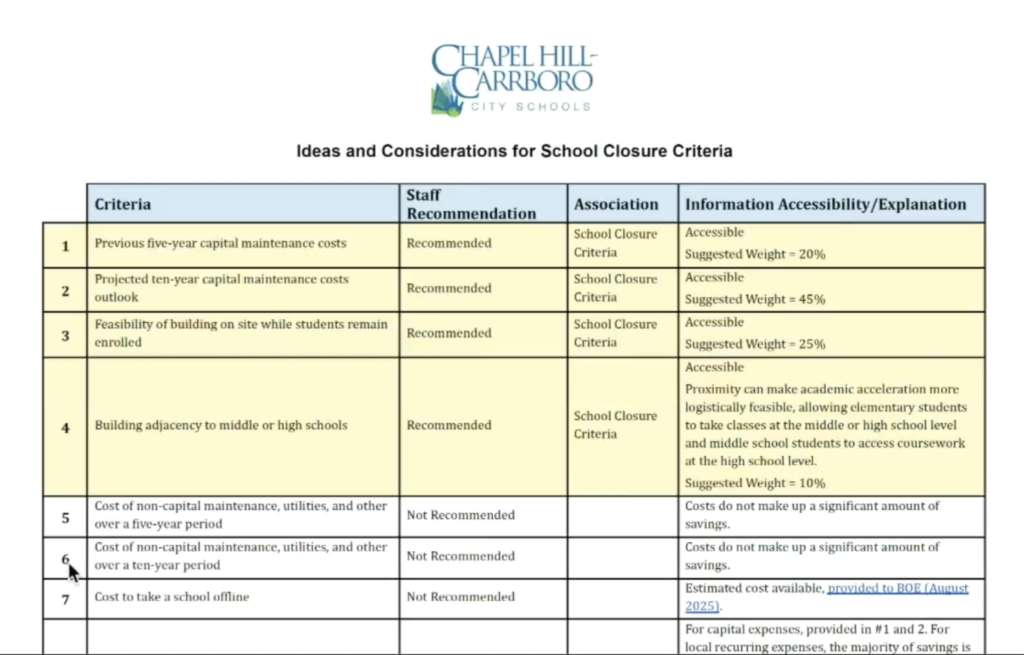
CHCCS staff have discussed using a short list of “closure criteria” to guide decisions. In staff-prepared recommendations released the morning of the February 19 board meeting, CHCCS staff proposed only the following four criteria out of a list of 64 potential criteria:
- Previous five-year capital maintenance costs (suggested weight = 20%)
- Projected ten-year capital maintenance costs (suggested weight = 45%)
- Feasibility of building on site while students remain enrolled (suggested weight = 25%)
- Building adjacency to middle or high schools (suggested weight = 10%)
The Board’s February 19 discussion brought some welcome course corrections. But the core governance problem remains: the district is still trying to make a community-defining decision with a facilities-first scorecard that blurs very different outcomes and omits some key factors.
What improved after the board discussion on February 19?
The most notable shift is that board members pushed back—at least partially—on the idea that four facilities-driven metrics are enough. Several members raised the obvious: if we are talking about permanently closing schools (not just replacing buildings), then we must study impacts families actually experience.
In particular:
- There was discussion of adding transportation costs / impacts (even if imperfectly measured).
- There was support for an equity impact analysis that looks at undue burden across student populations (students with disabilities, multilingual learners, socioeconomic groups, ethnic groups).
- There was momentum to include factors like site adequacy, campus openness/safety, alignment with town planning, and geographic/environmental conditions (including flood risk).
- One board member also questioned the logic of “adjacency to middle/high schools” as a meaningful criterion for an elementary closure decision—indicating that the rationale (academic acceleration) is not compelling.
This is all movement in the right direction. It signals that at least some board members understand what many families have been saying: you cannot treat “closure” as a spreadsheet exercise.
Are we closing facilities? Or are we ending school communities?
Even with the expanded list, there has been a lack of clarity from CHCCS staff and the board on what, exactly, they propose to do. Here’s one way to think of it. In the next few months, the CHCCS Board is making two decisions:
- Decision A: Facilities action. Which buildings have the greatest need, and what capital plan should address that need? Should we close a building, repair it, or replace it?
- Decision B: School community outcome. Are we keeping the school community as intact as possible, or are we permanently closing the school and reassigning students?
Those are not the same decision, and they should not be governed by one blended rubric. When we use the same word—“closure”—to describe (1) closing an old building after a replacement is built while the school continues, and (2) permanently dissolving a school community, we guarantee confusion and mistrust.
A facilities rubric can rank buildings. It cannot, on its own, justify dissolving a school community.
The state requires CHCCS to consider additional factors.
During the discussion, the board attorney reminded members that certain topics must be addressed in the study because they are required by statute,— specifically: including the cost of providing additional facilities.
- Geographic conditions
- Anticipated increase or decrease in enrollment
- Inconvenience of hardship on pupils affected
- Cost of providing additional facilities
Over the course of the board’s conversation, the first three items were added into consideration. The fourth was not, on the grounds that overall low building utilization across the district and the planned redistricting process means there is no cost to provide additional facilities for any school that might be closed.
Even if the eventual analysis concludes that this factor is similar across options (because redistricting will fill empty seats), it still needs to be explicitly addressed.
What about all the housing that is being built?
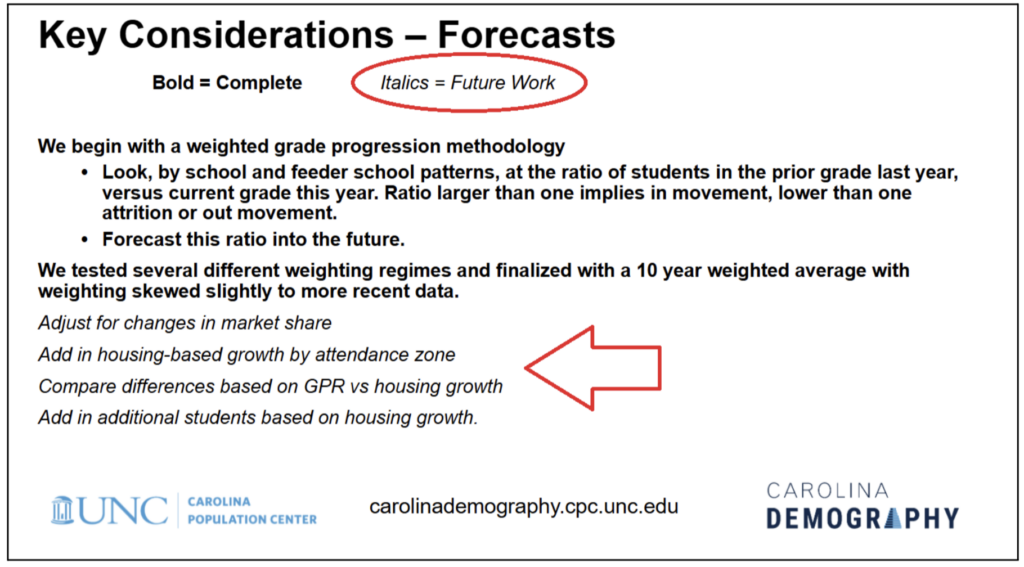
In a district where enrollment decline is tightly linked to housing affordability and development patterns, housing is a critical factor. A TBB article that will be published later this week will show that our future school enrollment projection might be rosier than Carolina Demography’s estimates suggested, in large part because they did not account for political changes (which happened in 2021) that are now bearing fruit in the form of more housing that is suitable for families.
Many of the new developments around town include townhomes and larger apartments, something that was not true for most of the housing that was built between 2010 and 2021. We encourage CHCCS to ask Carolina Demography to take into consideration the several thousand new homes that will be built in the next five years, something that they did not do in the analysis presented to the board in December.
Some criteria still look “designed,” not discovered.
Two criteria in particular continue to raise red flags:
- Feasibility of building on site while students remain enrolled
- Adjacency to middle/high schools
With the prospect of closing two school buildings on the table, the need to build on site is sharply diminished. For example, if the board decides to replace Estes Hills on site, they can simply relocate students temporarily to another closed school during construction. As the CHCCS Board learned last Thursday, building a new school on site while students remain enrolled in the current school building carries with it other costs, such as removing trees and expensive site preparation, that may no longer be necessary.
And, for the second criteria, while adjacency to a middle/high school has some advantages, if it is weighed too heavily, it effectively allows the CHCCS Board to pretend to be neutral while putting their thumbs on the scale for one outcome (of the five schools up for discussion, only two–Seawell and Estes Hills—are adjacent to middle schools.) If the board proceeds with using weighted factors to make a decision, we encourage them to include more criteria, and consider how weighing one attribute over another changes—or does not change—which option looks most appealing.
How to engage the community
Again, we recognize that this is tough. But we encourage CHCCS staff and the board to do the following.
Stop using “closure” as a catch-all, and define options precisely.
It will be helpful if the CHCCS administration distinguishes between the following options:
- building closure and replacement, either on site or off site
- program closure
- permanent school closure, or dissolving school communities that are defined by place (i.e., a school that has a walk zone, or is in a section of town that has no other schools nearby)
For example, FPG Bilingüe and Glenwood STEAM2 magnet schools are programs, like LEAP, the Newcomer Program, pre-K, and AVID. While FPG and Glenwood are currently in independent school buildings, this is not a requirement for them to continue. In fact, Carrboro Elementary already successfully operates a Spanish dual-language program within a school that also includes English-only instruction. Likewise, the CHCCS Board once considered consolidating its pre-K program at Lincoln Center, only abandoning it when costs to repair Chapel Hill High went up.
Even though the Board has stated that they will not cut programs, they should make those costs explicit. Even small reductions in programs may make them sustainable, and thus less vulnerable going forward.
Discuss district-wide school site needs.
Land is expensive, and many CHCCS schools were not built in places that were ideal in terms of transportation, walkability, equity, and many other factors. Using facilities needs and the principles of the Woolpert reports is fine to identify school buildings that need attention. But now that closure is part of the discussion, a facilities-only consideration is insufficient to determine which schools should be rebuilt and which would be shuttered.
For example, the CHCCS Board rightly abandoned the idea of building a second school next to Morris Grove, in part because it is on the edge of the district, and would present considerable transportation and equity issues. Likewise, it would be unwise to close a school that is located close to homes, jobs, and services, while keeping schools open that are more inaccessible to many in the district.
Consider all the schools.
The criteria themselves are necessary elements of the conversation, but on their own they are not sufficient. It is essential that the criteria be embedded in a transparent process that applies without favor to the broadest set of schools.
The CHCCS board has changed course several times on which schools are even included in their discussion. This creates confusion, and greatly heightens tensions between school communities, which is an outcome that the board must strenuously avoid. The most defensible process is to apply the selected criteria to all elementary schools in the district, and let the data do the talking. Some schools will clearly fall out of the conversation immediately — and that’s fine. If the board applies the same criteria to all schools, they and the community can have confidence that the process was fair and transparent, and that no school was favored over any other.
What can you do?
If you want this decision to be careful, compliant with state law, and community-centered—now is the moment to insist on it.
- Email the CHCCS Board and ask them to:
- use precise definitions (building replacement vs program closure vs permanent school closure),
- separate facilities triage from permanent -closure decision criteria,
- explicitly include all required statutory study elements, and
- add walkability, program impacts (all programs, including Pre-K), and realistic housing/growth inputs to the analysis.
- Contact your elected officials in Chapel Hill and Carrboro and ask them to publicly share their concerns and plans—because school closures reshape transportation, land use, housing patterns, and neighborhood cohesion, which are municipal responsibilities too. Here are three things Chapel Hill and Carrboro town councils could do to make our district more welcoming to families:
- allow diverse housing types in our neighborhoods. Townhouses and duplexes are more affordable to build and buy than single family homes, and the high cost of land in our community makes it financially infeasible to build new single family homes for less than a million dollars.
- change zoning rules to permit neighborhood daycares. A family friendly neighborhood offers a continuum of services, from affordable childcare down the street to a neighborhood school nearby. Permitting people to operate neighborhood daycares would increase the availability and lower the price of child care.
- Commit to working with the CHCCS school board on planning for growth. Too often, our elected officials are siloed, which leaves us all worse off. A joint public meeting in which council members in Carrboro and Chapel Hill share their housing, transportation, and equity priorities with the CHCCS Board would be very helpful.
- Write the Orange County Board of County Commissioners and ask them to work with CHCCS on short-term bridge funding and joint planning, so “closure” is treated as a last resort, not the first lever pulled under time pressure. The county can also work with CHCCS to build housing for teachers and other government employees on county-owned land, which will make it easier for us to attract and retain great teachers.
If you have time, consider attending the next meeting of the Chapel Hill and Carrboro Town Councils and the Orange County BOCC and make a public comment. The county controls the school budget, while the towns decide how much housing can be built in our communities.
And, finally, let us know if you have ideas about how to address this issue. Our community should come out of this process stronger and more united, not divided and concerned for what the future might bring.
Alyson Culin is a parent at Ephesus Elementary School and also sits on the Ephesus School Improvement Team.
Martin Johnson also contributed to this post. His children go to Smith Middle School and East Chapel Hill High School.