
To say childcare is expensive in Chapel Hill would be an understatement.
I am a full-time childcare professional who has worked closely with many families in the Triangle, including Chapel Hill. I’ve worked in day care centers and as a private nanny. As a result, I have first-hand knowledge of how hard it is to find childcare, and the many barriers that exist to people like myself who would love to eventually operate their own day care.
What I’ve learned is that we need more day cares in Chapel Hill, but currently the town makes it hard to open them in our neighborhoods, where they’re needed most. Through a simple vote, the Chapel Hill Town Council can lift the ban on neighborhood day cares.
What I’ve learned from parents
For many parents, child care costs as much, or more than, their rent—between $1,500 and $2,000 a month per child, and that’s just for day care or preschool.
Even though you only need child care for a few years, the costs still add up. Money that could have been put toward a downpayment for a house, into retirement savings, or used to pay the many other bills than any household faces are instead going toward childcare.
What’s worse, is that many families struggle to find any child care at all, no matter the price. Many of the families I nanny for turn to me only after failing to find suitable childcare for their kids. I nanny their kids while they wait to get off a waitlist they joined months, even years, earlier.
Mothers I talk to joke that the first person you tell you’re pregnant is not your partner, or your parents, or your friends, but the director of the day care where you’re hoping to send your child. Some parents only figure out the correct order of events after their first child is born. Or they hear it from parents who waited too long, and are now paying the price.
High quality child care should be available to all parents. But too often, families have to make very tough choices. Are they willing to add an hour or more to their daily commute in order to enroll their children at the place they like the most? Or do they settle for a private equity backed center that is convenient, but also expensive and has high staff turnover to boot? Do they hire a nanny? Or decide to work part-time or take a job where they can work at home, even if it derails—or ends—their career?
For too many families, all the options are not ideal. For others, the lack of day care options convince them to not have kids at all, or to have fewer kids than they had hoped. If we want our community to be for everyone, including young families with children, we need to address the high cost and limited availability of childcare.
What can we do to make childcare more affordable?
Many of the causes for the high cost of childcare are beyond the control of local governments. As much as we might want to do so, even a small subsidy program for parents of young children would quickly become cost prohibitive. And, state and federal governments place requirements on child care centers, from the size of the facility to the student-teacher ratio, that drive up costs further. These are good regulations. We want our children to have access to the outdoors, and a low student-teacher ratio ensures that every child gets the support they need.
But there is one thing that the Chapel Hill Town Council could do–lift the ban on operating day care centers in our neighborhoods.
Why do we ban neighborhood day care centers?
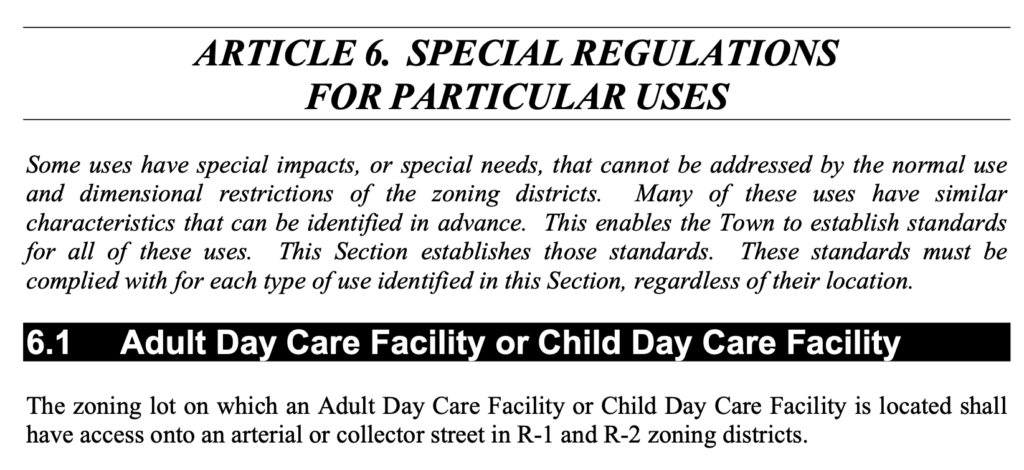
In the 2003 Land Use Municipal Ordinance (LUMO), which governs how we use land in Chapel Hill, adult and child day care centers are permitted in all zones. This means that if you want to open a facility that provides a service that we all think is important, you can do so, even if it’s in a residential neighborhood.
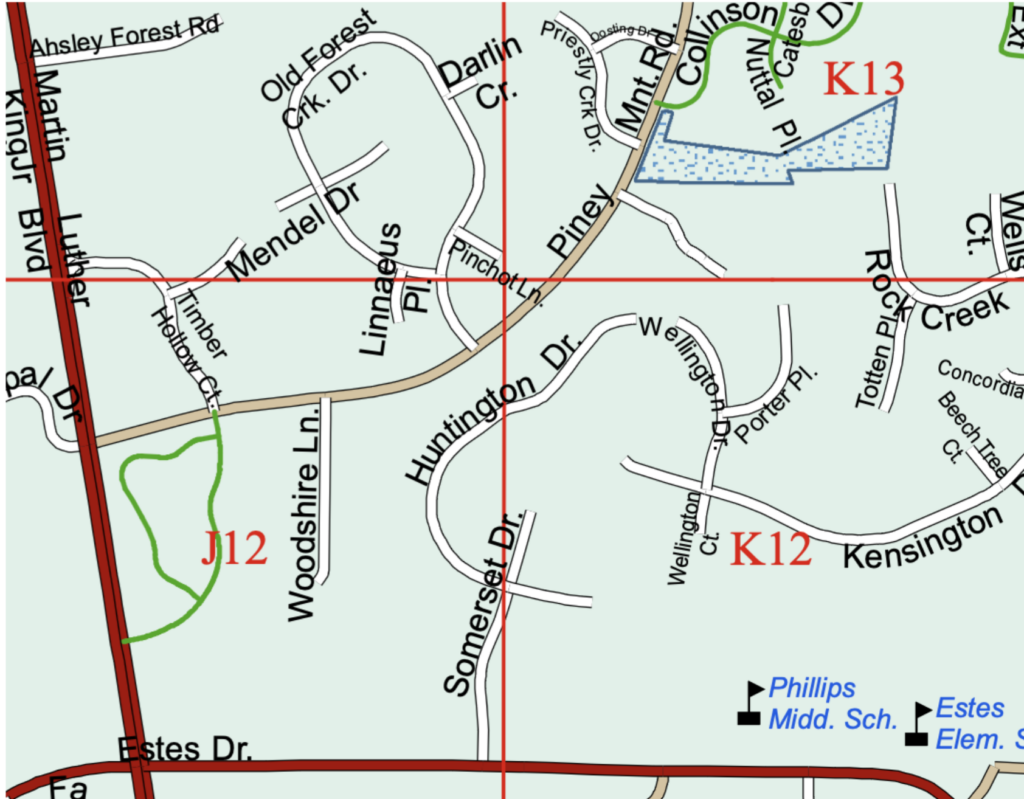
But, the LUMO also includes a loophole. You can only open a day care center in a residential neighborhood (R-1 or R-2, which is a lot of land in town) if it’s located on a major street, which traffic engineers call “arterial” or “collector” roads. Here’s what this looks like in practice:
In recent years, the Chapel Hill Town Council has approved several large developments at the corner of MLK and Estes. Soon, there will be hundreds of new families moving here, and, with the elementary and middle school nearby, we expect some of them will be looking for childcare before their kids are old enough to attend school.
But this presents a lot of problems. Most of the land adjacent to MLK and Estes is already developed, and the land that remains would likely be purchased by someone who wants to do something that’s more profitable than opening a day care. (In addition to child care being incredibly expensive, many of the centers have trouble staying open due to high operating costs).
While opening a center on Piney Mountain Road might work, people who live nearby know that it’s a challenge to get over there, particularly from the places where we’re building homes.
Meanwhile, converting a home on Somerset, Huntington, Wellington, or Kensington into a childcare facility would be perfect. There will be enough families living nearby that they could walk or bike with their kids to school, and children would be sheltered from high traffic streets. (Playing outside is great. Breathing in car exhaust because town rules require that day care centers are on busy roads? Not so great). Some of the most beloved day cares in Chapel Hill are in converted homes, which shows that the barriers to neighborhood day cares are mostly arbitrary Chapel Hill rules, not state regulations.
Making it easier to find a place to open a day care will also help people who want to run small, play-based non-profit centers, which are the best for kids and in keeping with our community’s values. While the ban is likely in place due to misplaced concerns about traffic, more neighborhood centers will reduce traffic in town, as many people will choose to go to a day care in their neighborhood rather than drive across town because there aren’t any nearby options.
What can we do to change this?
This is the easy part. The Chapel Hill Town Council can, through a simple text amendment, remove Article 6.1 from its current LUMO. Other communities have made similar changes, and have seen neighborhood day care centers open up.
This rule change will also benefit adult day care centers, which give senior citizens the support they need to stay in their homes. We already have at least one in Chapel Hill, and more are needed, particularly as the number of senior citizens in our community grows.
While eliminating the ban on neighborhood day care centers won’t solve things overnight, it will help. We’ll make our communities more appealing for young families, which will make it easier to keep our elementary schools open. The council should repeal the ban on neighborhood day cares, and look for other things they can do in the new LUMO to make it easier to start a day care in our community. We need them.
Please write to the Chapel Hill Town Council and let them know that you support day care facilities everywhere.
Martin Johnson contributed to this article.