
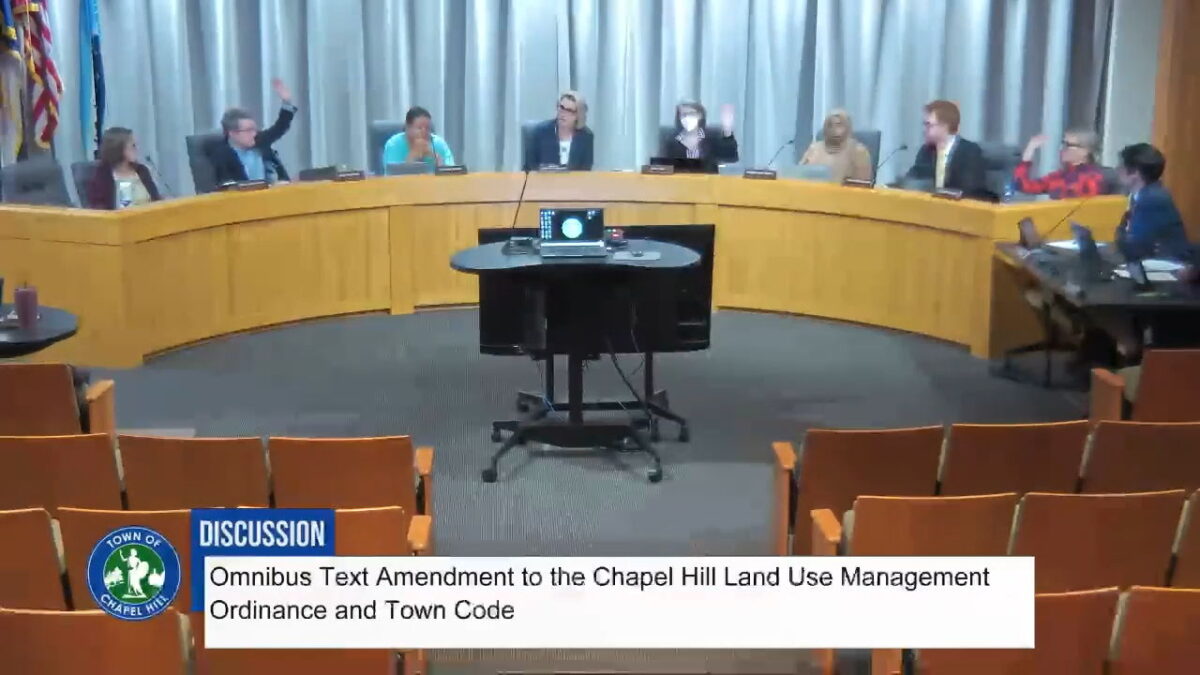
Well, that was a mess.
Earlier this week, the Chapel Town Council tripped all over themselves to sabotage an ordinance they, themselves, requested from town staff.
Some background: The town’s Land Use Management Ordinance (LUMO) controls how land can be used in the town, stating what you can build, where you can build it, how big it can be, and so on. However, the ordinance is confusing, contradictory, and no longer serves the town well, so the town has been working to rewrite the entire ordinance for almost a decade. Because it has taken so long, council members asked staff to make some priority changes to the current code.
And that’s the origin of the “Omnibus Text Amendments to the Land Use Ordinance.” Building on the efforts in 2023 to allow Chapel Hill residents to build duplexes in much of the town, the changes were intended to pare back some of the restrictions that have made it practically impossible to build duplexes, streamline the development process, better support “Complete Communities” by eliminating minimum car parking requirements, and implement some other changes that address pain points that the staff encounter when they are processing development applications, TBB’s Geoff Green recently wrote about its benefits.
The opportunity here was to address some of the low-hanging fruit. We’re a town that wants to prioritize biking, walking, and transit, so it’s wild that we still require a minimum amount of car parking while Raleigh (Raleigh!) and Durham do not. The restrictions on duplexes have been shown to be unworkable, so staff proposed changing some, based on their own research and feedback from the development community. Some of our processes are, to put it kindly, unique to Chapel Hill and don’t provide much benefit, so they were proposed to be streamlined.
These were not wild and exotic changes. They weren’t going to transform the Village of Chapel Hill into Manhattan’s Financial District. On the contrary, they were measured, incremental changes that were designed to improve our land use rules until the new LUMO is completed. We are fortunate to have an experienced and competent staff that works with the LUMO daily, understands its issues, and knows the changes that are needed.
Staff started work on these in April, when former council member Karen Stegman suggested during a council meeting that staff prepare some amendments to the current LUMO to address critical issues before the new LUMO was ready. At a May work session, staff received feedback from council on issues that should be included in the package of updates.
The proposed changes were first published in early October, when they were dropped on the Planning Commission agenda. These changes were no surprise to council members. Aside from the council meetings mentioned above, planning staff made numerous presentations to Council about the LUMO rewrite and received feedback about changes that should be made. And, let’s not pretend that there’s this great wall between Council members and Town staff; we’re sure planning staff took the temperature of the Council to make sure the proposed revisions were consistent with their preferences before releasing them.
There was a public hearing in front of Town Council on October 22. Some town residents spoke in favor, others spoke against. Council members had some questions and comments, but everyone seemed supportive. No one gave a hint they were going to oppose the omnibus because of some detail in the package.
Then came Wednesday’s meeting. It seemed smooth sailing at first, with staff making its presentation and council asking some clarifying questions. It was after that point that things went south. Council member Amy Ryan had identified a series of amendments to the omnibus that she wanted her fellow council members to approve. One was entirely noncontroversial and removed the small set of projects for which Planning Commission would continue to perform (meaningless and unnecessary) site plan review. This one was adopted unanimously.
Another amendment sought to make the concept plan process optional instead of eliminating it altogether–this failed by a tie vote. Again, though, this was in our mind a marginal issue, and not an issue that was going to torpedo the whole package. If I were a council member, I’d have probably voted against it, but I wouldn’t have been too concerned if it had passed.
Two amendments dealt with some of the parking changes staff had proposed for duplexes. Following some back-and-forth, this proposed change was withdrawn from the package, so the current language in the LUMO would have remained.
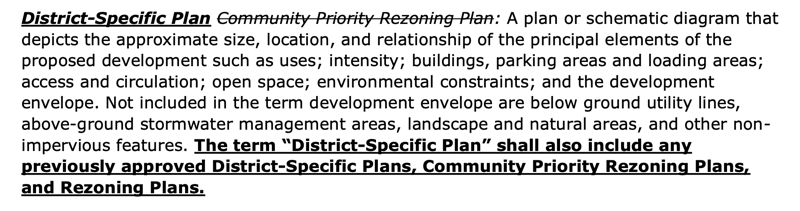
One amendment dealt with the definition of a “district-specific plan.” I did not and still did not understand the amendment or the lengthy discussion that ensued. It is important to note that the omnibus did not change what was included in a new “district-specific plan,” it just made some updates to make clear that some plans that council had previously approved were included in the definition.
Now, the LUMO’s definition of “district-specific plan” is a bit of a mess. But council member Ryan deemed it a critical issue that required an amendment. By the end of the discussion, it seems to us that no one (including three blog bloggers who are/were Planning Commission members) were quite clear what impact the amendment would have. This one failed by another tie vote.
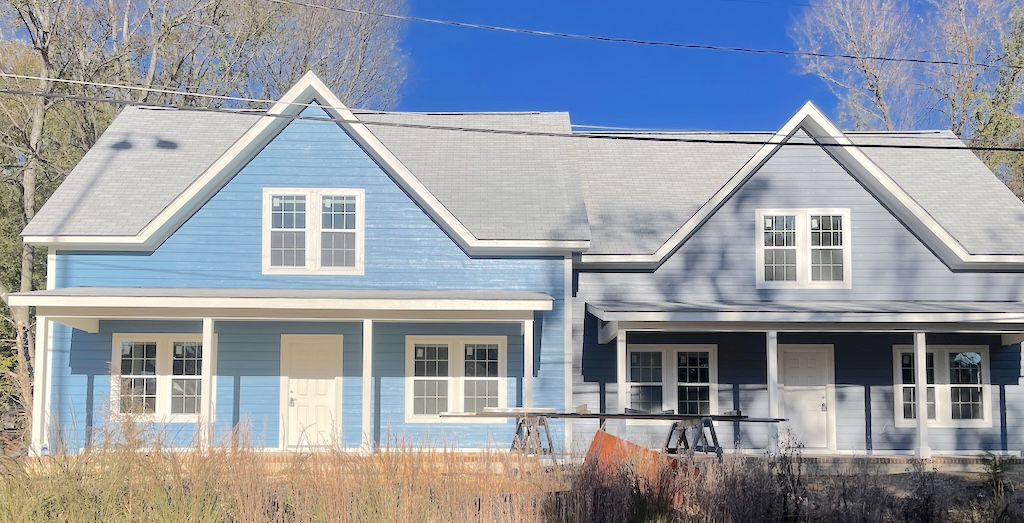
The last issue concerned the maximum size of duplexes. In the current LUMO, the maximum size for an entire duplex is 3,000 square feet–that includes both units, as well as any interior area shared by both units. So, at most the maximum living area is an average of 1,500 square feet. Town staff proposed increasing it to 5,000 square feet, which is consistent with the size of some affordable housing duplexes that recently have been built in Chapel Hill. Council member Ryan’s amendment proposed to limit the maximum size to 3,600 square feet. This minor change is reflective of the inadequate and technocratic nibbling at the edges that has gotten us into this housing mess in the first place.
This proposed amendment failed by another tie vote.
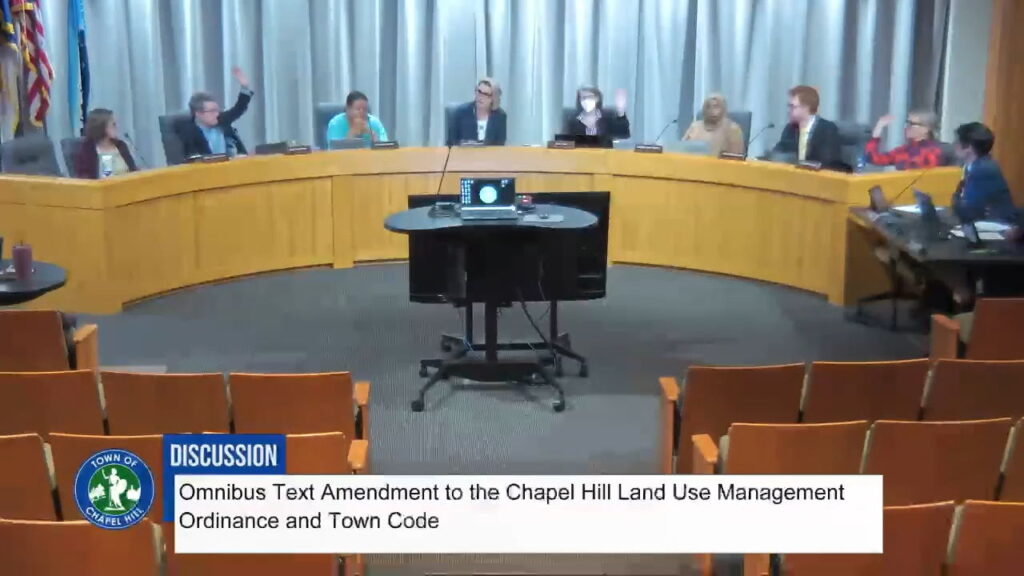
With the amendments dealt with, the council deemed further discussion unnecessary (they’d been there three hours) and swiftly moved onto a final vote on the package. Once again, it was a tie vote, 4-4. The omnibus was not adopted. Months of work fell by the wayside.
Why did three council members and the mayor vote against it? Great question. Often, council members will announce the reasons for their vote before a vote is taken. Here, that didn’t happen, probably because council members were tired after debating the issue for three hours. But if you’d listened to the comments at the public hearing on October 22, or the discussion at Tuesday’s meeting, you’d have thought the amendments would pass easily. No one identified flatly unacceptable elements of the proposal; no one asserted that their vote was contingent on changing or eliminating a provision or modifying some language. (No one raised an issue about the “district-specific plan” definition previously.) Sure, it’s unlikely Adam Searing would have voted for it, but it looked like approval by a 7-1 or 6-2 vote was possible, and a 5-3 approval was almost certain.
If a council member or mayor thought one of the proposals was a poison pill, something they could never support, it would have been good to mention that at some point so that other council members could take that into consideration. While it would be good to have all the changes, some would be better than none. Eliminating minimum parking requirements would be a really big deal by itself. Maybe some council members could have tried to reach a compromise.
No such compromise was sought or found. Council members Ryan, Searing, and Elizabeth Sharp, along with Mayor Jess Anderson, voted against. Because of an absent seat on the council, the final vote was a shocking 4-4. The omnibus LUMO amendment did not pass.
Following the meeting, Council member Theo Nollert (who voted for the measure) wrote about his disappointment in the outcome. I haven’t seen any public comments from the nay votes on why they made their decision.
So, for now, these modest reforms to the LUMO are dead.
For now.
Because, beginning on December 3, we’ll have a new council. Adam Searing is off, and Wes McMahon and Louis Rivers III will join to fill Searing’s seat and the seat vacated by Karen Stegman. Both McMahon and Rivers served on the Planning Commission in recent years, and McMahon was one of the unanimous Planning Commission members who recommended that the Town Council adopt the amendments during the October 7 Planning Commission meeting. So, there’s a good chance this package of proposals can get adopted as drafted.
Maybe this short-term failure will mean more medium-term success. Council member Nollert wants to go even further than the omnibus proposal, writing that he plans to propose legalizing triplexes (three-unit dwellings) and fourplexes (four-unit dwellings) throughout the town, as was originally proposed in the 2023 housing choices amendment before it was watered down.
One of the key goals of the Chapel Hill Alliance for a Livable Town (CHALT), and the politicians they supported, was to block significant changes to our land use regulations so that we were stuck in amber and Chapel Hill 2025 = Chapel Hill 2010. It has been the case for at least 15 years that amendments to the LUMO have come in widely spaced starts and stops, much of that due to CHALT’s efforts to throw sand in the governing wheels. This past election cycle, however, CHALT faded away, and we have four newly elected council members (McMahon and Rivers, along with returning council members Miller-Foushee and Berry) who supported the proposal. Each appears ready to move forward with much-needed updates to our land use regulations.
We’re excited. January can’t get here soon enough.