
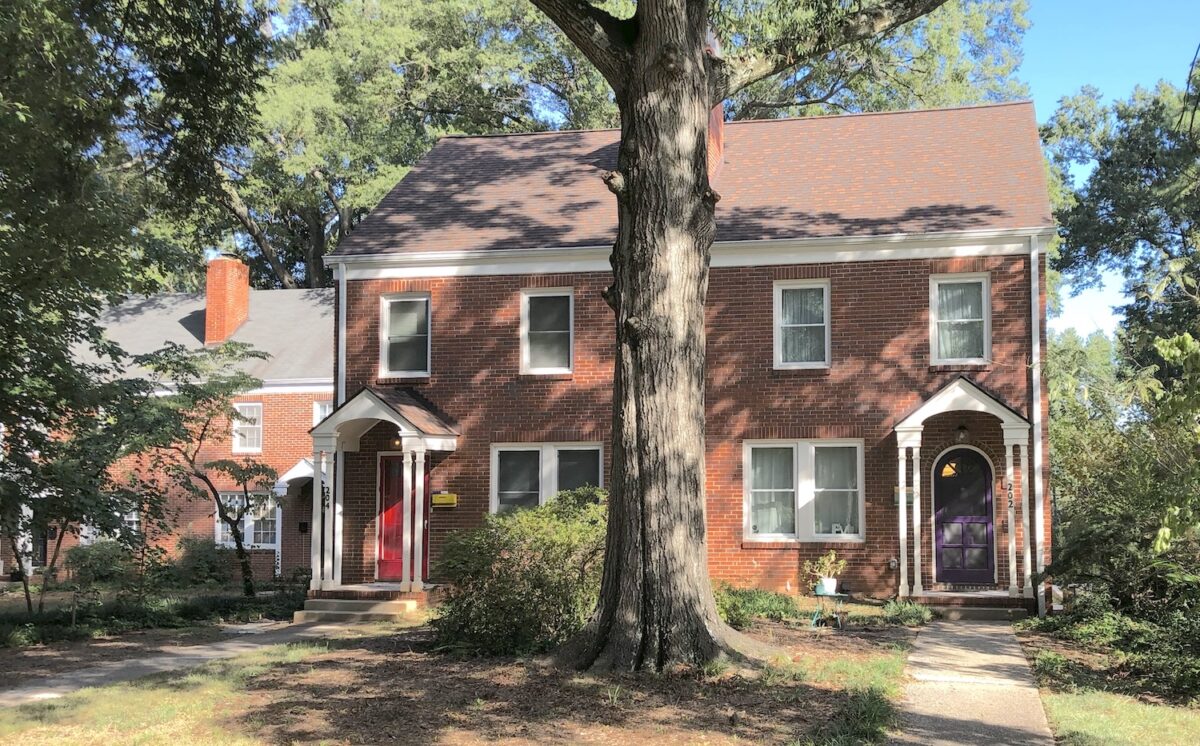
Back in 2023, it was a big deal when the Chapel Hill Town Council approved the “housing choices” amendments to the town’s Land Use Management Ordinance (LUMO), the set of regulations that control how land can be used and developed in Chapel Hill. As a community, we took a big first step to move away from our exclusionary zoning regulations that, for generations, allowed only single-family homes to be built on most land in the town.
The housing choices amendments allowed duplexes (two-unit buildings) to be built in most zoning districts, made it easier to building accessory apartments (also known as “accessory dwelling units) on properties with existing single-family homes, and added a new use called “single-family plus cottage” which is a variant of a duplex with two buildings on a single lot.
But before the majority of the Town Council agreed to adopt the housing choice amendments, council members insisted on adding additional regulations that made it harder to build these types of housing than the single-family detached homes that are built throughout Chapel Hill.
The end result? Not much has changed. Contrary to the ludicrously overheated paranoia of opponents of the housing choice amendment, our neighborhoods have not been ruined by swarms of duplexes. In fact, it’s not clear any have been built. Even if there are a few, it’s not helping address our need for additional housing or providing.
More clearly needs to be done. Additional updates to boost make it easier to build housing are expected to be incorporated into the fully rewritten LUMO, but that project has been long delayed. Therefore, at council’s direction, staff has proposed additional amendments designed to help accelerate housing production and meet the goals of 2023’s housing choices effort. The Town Council opened a public hearing on the amendments a couple of weeks ago (video), and will continue the public hearings and potentially make a decision next week. The package of amendments also includes some other changes that bring Chapel Hill more in line with other progressive communities, such as the proposal to eliminate requirements that new developments provide a minimum level of car parking. These updates will better support our efforts to develop a bike, walk, and transit-friendly community.
Eliminating counterproductive limitations on duplexes
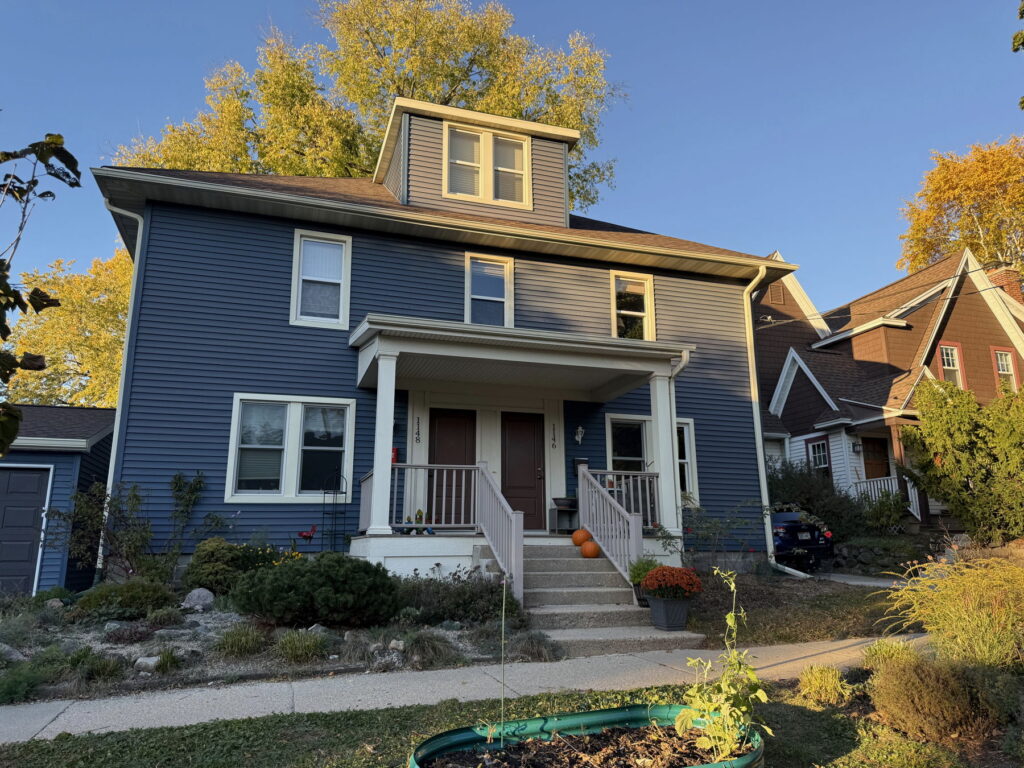
The 2023 housing choices amendment allowed duplexes in more zoning districts, which is a huge deal. Because duplexes have shared walls, they are generally less expensive than homes on their own lot. Because of their scale, they can fit comfortably into neighborhoods with predominantly single-family detached homes. Just take a look at this cute duplex I found in another college town.
Unfortunately, duplexes are subject to regulations that do not apply to single-family homes. These limitations include a tree canopy requirement, restrictions on car parking, floor-area ratio restrictions, and limitations on the size of each unit in a duplex.
For example, there is no tree canopy requirement for new single-family homes. But, council insisted on a 40% tree canopy requirement for duplexes. This means that someone building their dream single-family home could cut down every tree on their lot and not plant new ones (or plant as many or as few as they want). If you’re building a duplex, though, nearly half of the lot needs to be covered by tree canopy. That can be a pretty big challenge, particularly compared to the (nonexistent) requirement for single-family homes.
Single-family homes can be as large as they want. But, duplexes are limited to a total size of 3,000 square feet, or 1,500 square feet per unit. Today, the average new single-family home in the south is about 2,500 square feet, so limiting duplex size to 1,500 square feet reduces its attractiveness to families.
There is no maximum floor-area ratio (measured as the ratio of interior floor area to the size of the lot) for single-family homes. (Learn more about floor area ratio here.) You can build what you want as long as you meet the relevant standards (most notably lot setback requirements and maximum height). But, duplexes have a limited amount of floor-area ratio. Duplexes already have size limitations, and need to comply with setbacks, and need to leave room for required trees–the floor-area ratio requirement is another limitation that duplexes need to deal with.
The proposed amendments would relax some of these limitations. Maximum duplex size is increased to 5,000 square feet, so a duplex would better fit families. The floor-area ratio restrictions go away. Some parking restrictions are eased. These are much-needed changes. Sadly, the tree canopy requirement is staying. You’ll find plenty of single-family homes, particularly newer ones, that do not meet a 40% tree canopy requirement, and new ones won’t have to either. Trees are important, but imposing a requirement on two-family homes and not single-family homes is a mistake if developing more housing is a priority. Maybe next time.
One piece of important context: In many ways, our entire housing industry—including zoning, construction, and financing—is designed around single-family detached homes. Until recently, most communities only allowed single-family detached homes to be built by right on most land. Every other type of housing required special approval from elected officials; this gave neighbors an opportunity to protest and prohibit. Moreover, the majority of homebuilders work on single-family homes. Mortgage lenders and the federal entities established to help the housing market, such as Fannie Mae and Freddie Mac, focus on financing single-family homes that are owned on their own lots. This makes it harder to build and finance duplexes and other types of missing-middle housing. Given all these challenges to the development of duplexes, it is critical that zoning regulations not put up additional barriers.
Eliminating parking requirements
This is a big one. Like most communities, Chapel Hill requires any use to provide a certain amount of parking off street, usually based on the type of use (a restaurant is required to provide more off-street parking than a store) and its size. However, the amount of parking that any use actually requires is extremely specific to the context in which the development exists, and it can be hard to calibrate the requirements in the code to match actual demand. They often require more parking than is needed, which adds to the amount of impervious asphalt and makes it harder to get around without a car.
Because minimum parking requirements so often don’t get it right, these requirements have been going away around the country. Cities and towns as diverse as Buffalo, New York; Fayetteville, Arkansas; Birmingham, Alabama; and Lexington, Kentucky have all gotten rid of them. Locally, Durham and Raleigh have eliminated minimum parking requirements.
To my knowledge, no community that has eliminated minimum off-street parking requirements has brought them back.
This summer, the North Carolina House of Representatives approved House Bill 369 which would eliminate minimum off-street parking requirements statewide by a vote of 107-0. While the bill has not been voted on by the state Senate, it shows that there is overwhelming agreement that off-street minimum parking requirements are not a necessary part of development regulations.
New development will continue to provide off-street parking—recall that Wegman’s insisted on providing more than the maximum allowed by the town, although now they’re planning to sell of some of the excess. I have been to new developments in Durham and Raleigh and they do provide parking. But, it won’t be the town establishing an arbitrary minimum requirement that runs the risk of making it harder to get around by walking, biking, or transit.
Streamlining the development process
Chapel Hill’s development process is notoriously complex and slow. The town made some improvements to help accelerate affordable housing developments, which often need approval within compressed timeframes in order to meet grant funding deadlines. Some of these changes, and additional revisions, are proposed to apply more generally. These changes include:
- Removing Planning Commission from site plan review, except in Neighborhood Conservation Districts.
- Eliminating Planning Commission review of subdivisions.
- Removing concept plan review for conditional zoning applications (conditional zoning is how most new developments get approved these days), and allowing the Town Council to approve a conditional zoning application after one public hearing instead of two.
- Eliminating the role of the Community Design Commission (CDC) in reviewing (but not approving) design prior to issuing building permits for special use permits.
These are common-sense updates. As a member of Planning Commission, I can attest that our review of site plans and subdivisions is largely a waste of time. The sole criteria for approving or disapproving a site plan or subdivision is whether the application meets the standards of the LUMO. It doesn’t matter whether the Planning Commission might prefer a different building layout or different plantings or alternate parking arrangements; if it meets LUMO standards, it must be approved. We will sometimes have residents come to the meetings and give pubic comments about why a project should not be approved, but we are not the Town Council. We do not have discretion. If the site plan or subdivision meets the LUMO standards, we must approve it.
To substitute for the absence of a public hearing before Planning Commission, town staff propose hosting public information sessions so people can learn about the project without letting them think they can influence the decision. That seems fine, and staff is better equipped to take any feedback and make suggestions for changes to the developer than Planning Commission.
There has been commentary circulating that this change would “result in significantly less public engagement, which will in turn cause increased public frustration with Town decisions.” Nonsense. Today, complaining to Planning Commission regarding site plans or subdivision is a waste of effort. It gives people the appearance of making an impact, when they most certainly do not. And, the elimination of concept plan review doesn’t limit the ability of neighbors to comment on a proposal before Town Council.
Another comment is that the changes mean that “the town’s design standards, which in the past allowed council and the public to have a meaningful sense of what was being proposed, would now be replaced by automatic acceptance of vague general layout plans.” This has nothing to do with the proposal. Town Council continues to have the authority it has always had to approve conditional zoning and attach conditions around site layout or building design. And, should the Town Council believe that a particular application should have a second round of review due to its complexity or controversy, it is free to do so.
In fact, the changes should go further and eliminate the Planning Commission’s role in approving site plans in Neighborhood Conservation Districts. The rationale for eliminating Planning Commission review of site plans is just as strong for review of site plans in NCDs.
Grab bag of additional changes
The rest of the changes make tweaks to other parts of the LUMO, and most are small in scale. As staff notes, no one else requires Town Council review of a vague concept plan at the beginning of the development process. Experience teaches that this concept plan review doesn’t have much of impact on a project—and Town Council will remain the ultimate decision-maker.
The proposal provides some additional flexibility for accessory dwelling units (secondary housing units on the same lot as a primary house), and makes it possible to put an accessory dwelling unit on its own lot and sell it separately.
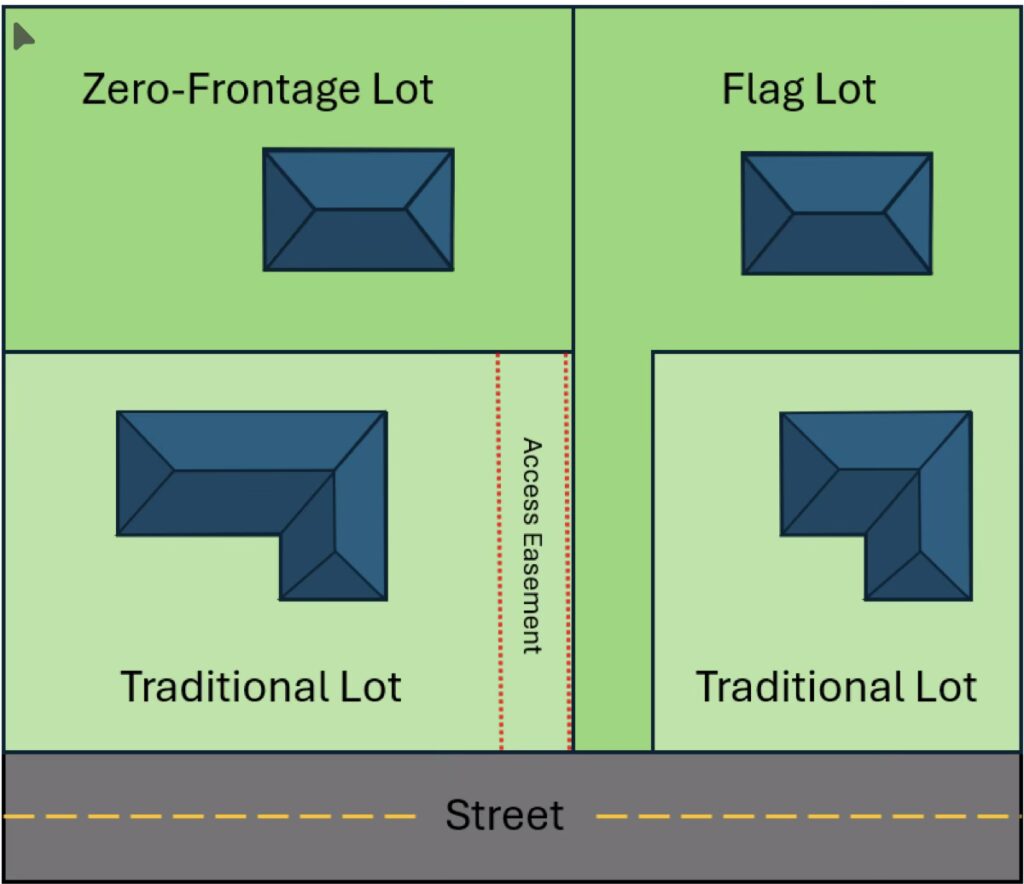
Some of the lot dimensions are reduced to provide additional development flexibility and permit more compact development in our neighborhoods that are dominated by single-family homes. For example, minimum lot size in the R-1 district is proposed to be reduced from 17,000 square feet to 10,000 square feet, and each lot can be narrower. It also makes it easier to build on “flag” or “zero-frontage” lots, which tuck behind a primary lot and have access along the flag to the street. This graphic from town staff illustrates how those work:
Small subdivisions (such as splitting one lot into two) would no longer be required to build a sidewalk or make a payment to the town in lieu of building a sidewalk; these requirements make it more expensive to build housing but do not provide much benefit. If built, the sidewalk won’t connect to anything, and it’s hard for the town to spend the in-lieu payment given legal limitations on how that money can be spent.
Finally, there are some small changes to the sign codes and some other provisions in the LUMO.
Let’s move forward
Town staff has proposed a modest set of changes to the existing LUMO to improve our development process. They are good ideas and Town Council should approve them.
Detractors have suggested that “these LUMO changes are essentially a backdoor way to expand the failed Form-Based Code (FBC) model adopted in May 2014 across the town”—making reference to the form-based regulations in the Blue Hill district. Setting aside what one thinks of recent changes in the Blue Hill area, this is absolutely false. This reference is meant to convince people that these amendments would allow large apartment buildings throughout the town, and that Town Council would have no say. These amendments would do no such thing. These are modest changes that eliminate some of the cruft from our regulations and try to encourage more modest, missing-middle housing like duplexes built.
These amendments won’t result in development nirvana. Much more needs to be done, and hopefully additional improvements will come in the brand-new LUMO that is due to be released next year. For now, these much-needed refinements to the current LUMO will provide some important updates to our land-use regulations.