
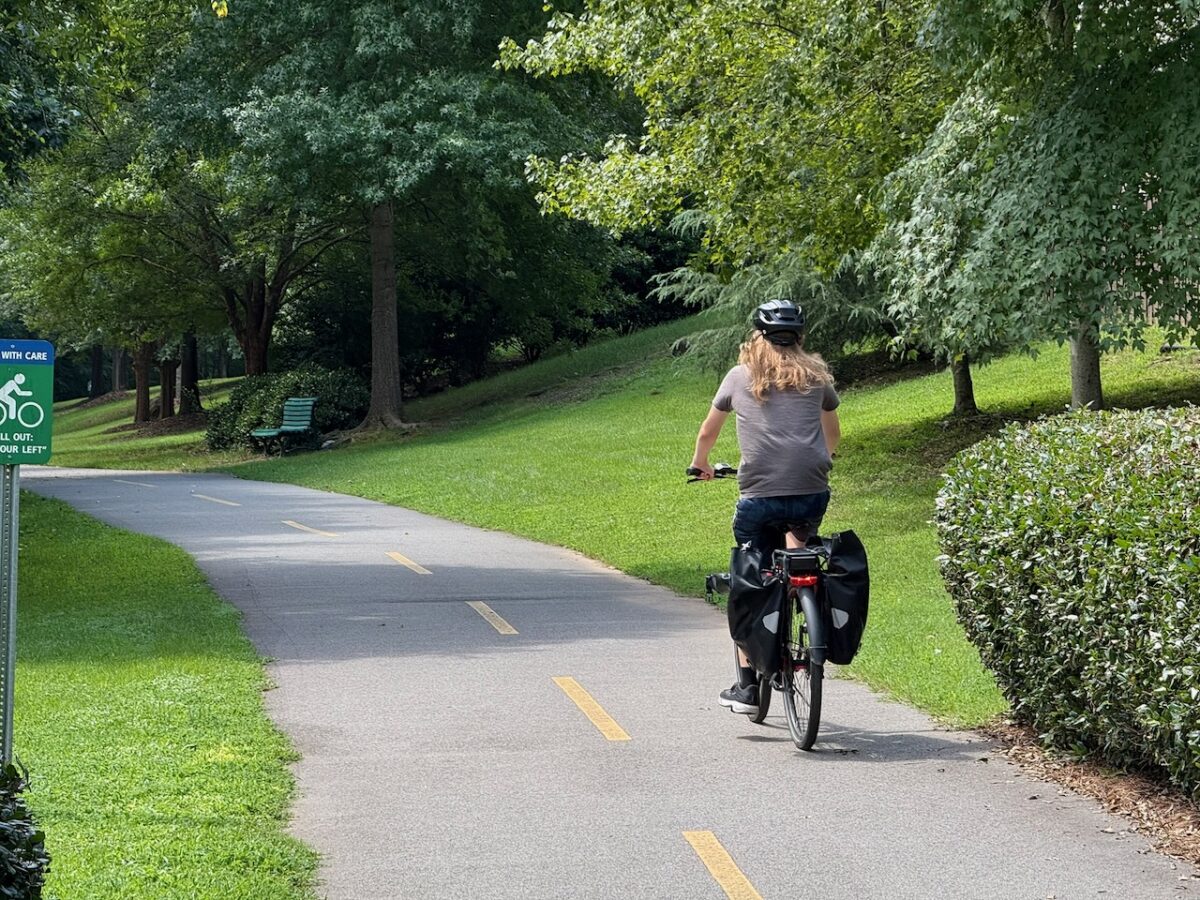
In the fall of her freshman year of high school, when my child suggested she would like to ride an e-bike to school instead of taking the bus, I was a bit skeptical. The route to school was 5 miles, she hadn’t ridden an e-bike very much, and what if it were rainy or cold? Would she really be willing to ride to school in a downpour? And, while much of the route involves low-traffic roads or greenway trails, there were still some tricky sections where she’d be riding with cars, and I wasn’t sure if she—or I—would be comfortable with it.
We swallowed our doubts and in December 2022 purchased an e-bike. She rode it a couple of times to school during some unnaturally warm weather (which I wrote about here). We then thought it was “too cold” to ride and so it sat in the garage until March, when the weather warmed, when she started regularly riding it to school.
Two-and-a-half years later, she hasn’t stopped. She recently hit a milestone and surpassed 5,000 miles on the e-bike.
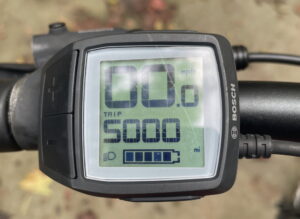
Much of that mileage was accumulated on her 10-mile round trip ride to school every day. She bikes to school all year long, when it’s hot and when it’s cold, when it’s clear or when it’s pouring rain. And, the 5,000 miles doesn’t count the several hundred miles she’s accumulated when she had to use my e-bike, because hers was being worked on at the shop.
We’ve learned a lot in the last few years. I’m sharing them in the hopes that they can help encourage others to consider not only using e-bikes to make daily trips, but also to help build support for the investments that make it possible for people like my daughter to bike to school. Facilities like paved greenway trails, bike lanes, and bike parking are critical to making it possible to make non-automobile trips that extend outside of one’s own neighborhood. These require not only investments in bicycling and walking, but also reducing the amount of money spent on making it easier for automobiles to get around and providing lots of parking. Imagine the cost savings if a school could install 200 bike racks instead of building 400 car parking spaces.
Here are her lessons from e-biking to school:
- If it’s cold, bundle up! We’ve bought warm coats, warm pants, face coverings, and gloves. She’s been comfortable biking to school even when the temperatures are down in the teens.
- If it rains, throw on some waterproof coverings, and get to school nice and dry, even when it’s a downpour.
- Beginning her sophomore year, she began to take math classes at UNC, which is about five miles from her high school. Getting there during the school day is tricky—there’s a bus, but it wouldn’t get her there and back in time to be on time for her classes. She was too young to have a driver’s license, and parking is limited around UNC. And, both her parents work. The e-bike gives her the freedom to get to UNC, and back to high school, all on her own. As a bonus, she locks her bike at a rack right in front of her classroom building; no searching for a parking space.
- An e-bike and necessary maintenance is much cheaper than purchasing a car. And, as I’ve pointed out before, the cost of “fuel” for an e-bike is much less.
- It’s good exercise that’s built into the day. On days she has classes at UNC, she’s biking around 20 miles–and yes, it’s an e-bike, but she still does a lot of the work herself.
- She can stay after school as late as she needs, or go visit a friend, while her parents are both at work.
- She hasn’t gotten a driver’s license, so we’ve saved a bunch of money on insurance.
- There’s a much lower chance she’ll cause thousands of dollars of damage or hurt someone versus driving a car.
- She skips the car driver’s line at school, which can take 25 minutes to empty out at the end of the school day.
- She’s not sucking in diesel fumes during school bus rides.
We thought $3,000 for a new e-bike was a lot, and it is. We’ve also paid several hundred dollars for necessary maintenance. But it has provided incredible advantages for our daughter, and it’s a lot less expensive than the alternatives.