
What a difference a few years and a new council makes. In 2023, a developer proposed a 12-story building on East Rosemary Street that would have included street-level retail space and 56 housing units, a quarter of which would have been dedicated units for affordable homeownership. Despite that council’s stated interest in a more vibrant downtown with year-round residents, and a nearby very expensive new parking garage it needed to fill, it voted the project down. The project was, depending on whom you asked, too tall or too near a historic district or the luxury units that would subsidize the affordable units were too expensive.
Fast forward a few years, and downtown Chapel Hill has seen little in the way of new development. The $50 million Rosemary deck, seen as a necessary tool for economic development, was completed but a nearby wet lab proposed by Grubb Properties did not materialize. An apartment building also proposed by Grubb Properties in the same block of Rosemary, and approved by council, also has not materialized. That’s left the town in an awkward position of owning a new parking garage plus the old Wallace deck Grubb was supposed to demolish for the wet lab, and town taxpayers on the hook for paying for the new parking garage to the tune of roughly $2 million per year. Adding insult to injury, UNC,which contributed to development of the new parking garage, is effectively bailing on downtown for Carolina North, fueled by Chancellor Roberts’suburban campus fantasies. The town wants new businesses that spin off from UNC researchers to locate downtown instead of in RTP or Durham, as they tend to do, but you can imagine that Roberts will want them to land at Carolina North.
I don’t know if the current town council had any of this on its mind as it considered a proposed mixed-use development for 306 West Franklin Street, but I certainly would have if I were them. Stuck with a new parking garage it never really needed, and one that now competes with its own Wallace Deck just a few yards away, and which is unlikely to spur economic development in the current climate, it needs new revenue quickly. Perhaps this explains, in addition to this council being much more pro-housing than the previous one, why there was so little debate about the proposed West Franklin project at the November 18, 2026 council meeting.
The proposal
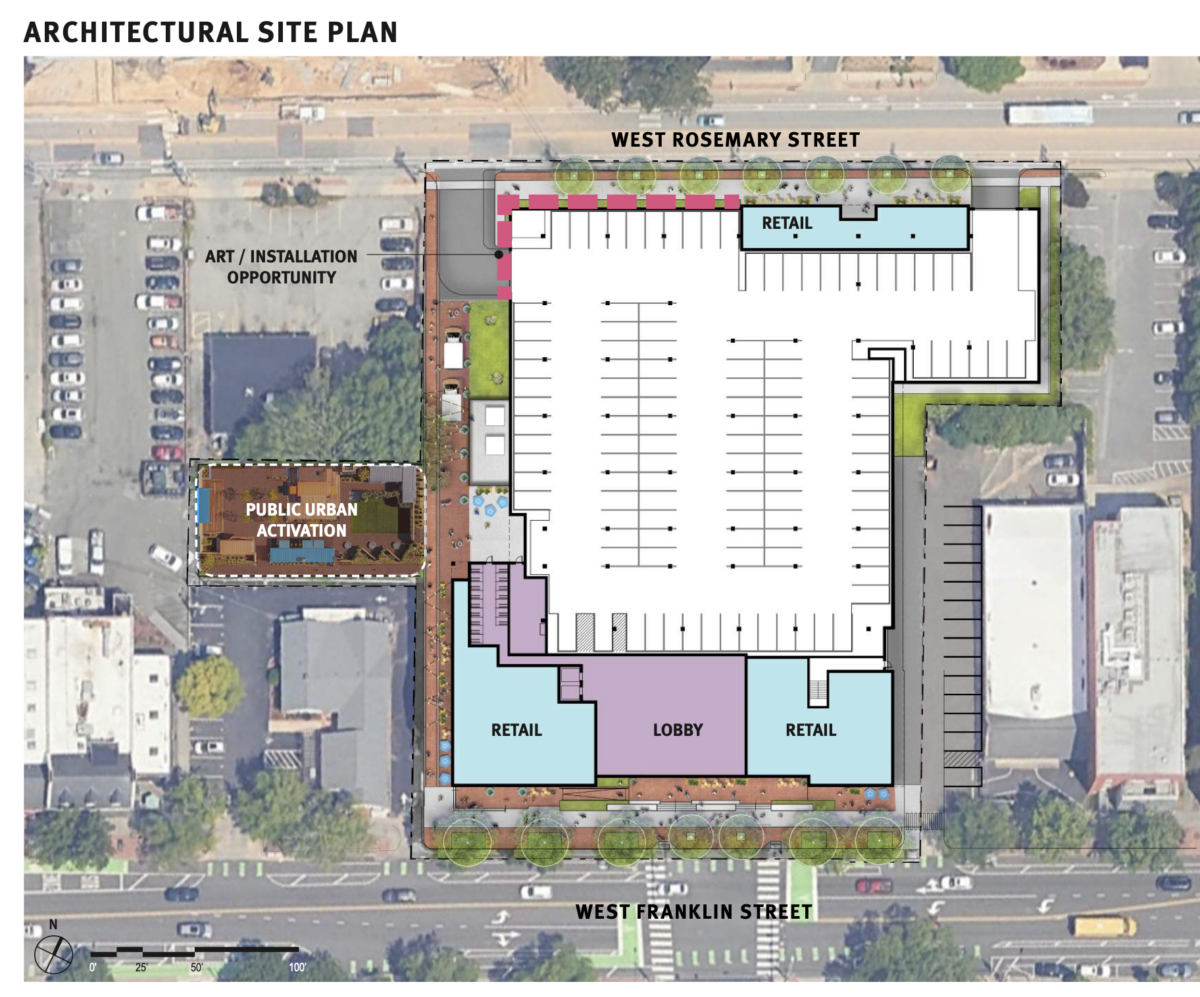
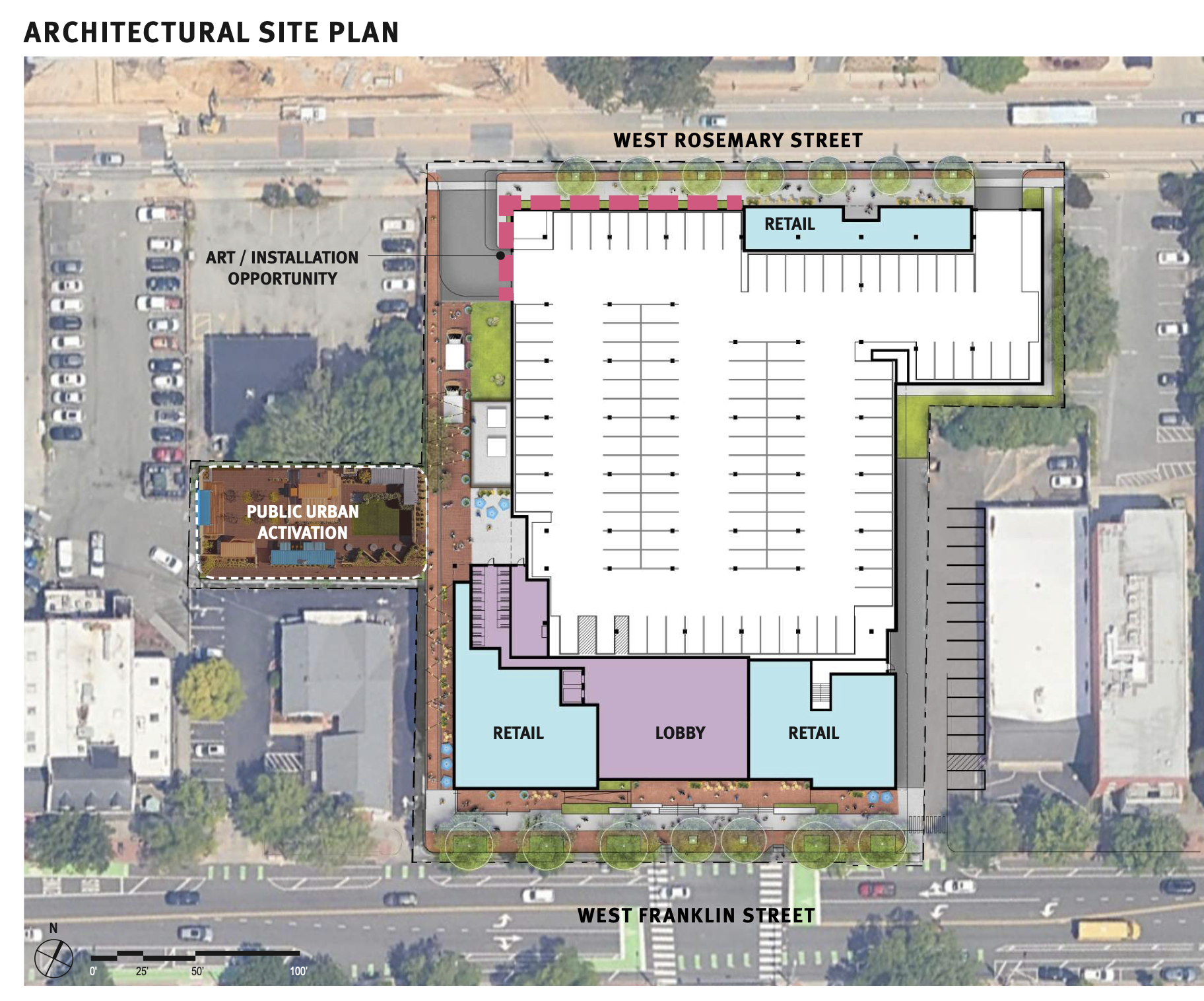
The town previously approved a redevelopment at 306 West Franklin Street for a wet lab. That project, however, never materialized – I imagine, due in part to the federal government unexpectedly abandoning science, wrecking an economic sector that has driven growth in the Triangle for decades – and the permit lapsed. The Boston-based developer shifted from a commercial to primarily residential property with street-level retail on both Franklin and Rosemary. The seven-story building would include:
- 200-250 residential units
- 240 parking spaces
- 5-10,000 square feet of retail
- a pedestrian connection from Franklin to Rosemary, wider than those elsewhere downtown, though parts of it will be shared by service vehicles
If you’ve paid attention to other proposed downtown residential projects, you may have picked up some patterns. First, developers try to act like they aren’t building student apartments even when they are. Second, they offer little retail space, knowing at best it will become a leasing office or at worst sit vacant for years. And third, they fight council over if and where affordable units will be offered.
As a former council meeting junkie who has tuned them out in the last year or so, I was shook to see how the developer (Damian Szary with Redgate) presented the project and justified his choices. And how council reacted to them. He made clear that the project will be designed for adults (college students are of course adults, but you get the idea). Specifically, adults with money:
Right now, the main demographic in downtown Chapel Hill is an undergraduate demographic. Vital to Chapel Hill, absolutely vital. But that’s the main demographic. And that’s why there are things such as vape shops and t-shirt shops, fast casual retail…. We absolutely value the students, but we think there could be more on Franklin and Rosemary Street if the right project is executed the right way. And it really revolves around bringing 12-month-a-year residents living in the urban core with disposable incomes…. As of last week, I am a homeowner of Chapel Hill. Really excited about it. I have two young kids. I am looking forward to the time where I can walk up and down Franklin Street and go to a toy store with my 8-year-old and 11-year-old. It would be amazing to buy a cool pair of sneakers here and not have to go to South Point. I think all those things can happen if we just think really thoughtfully about the demographics and what an urban area like this needs in order to really support it.
Saying out loud that money matters in pricey Chapel Hill, and affects development viability? You can tell this guy is new to town!
He also talked about retail in a different way than I’m used to hearing. I’ve griped for years that Chapel Hill doesn’t build densely enough to support the retail it wants. We have visions of Paris and Copenhagen but we build like Houston and Phoenix. We make developers add street-level retail we cannot support, which just makes new housing more expensive to subsidize empty or underutilized retail spaces that eat into a developer’s bottom line. Szary skipped right past the part of the presentation where the developer and council fight over retail:
What we are planning on doing and what we’re asking the council to consider is an affordable retail program for this space, specifically the 2,000 square feet on Rosemary. What we’re proposing is basically doing retail space that is no rent to the landlord. It’s zero rent. We are going to ask the tenants to pay for their fair share of expenses. An estimate for expenses for this building, share of taxes and any other maintenance, it’s roughly $10 a square foot from our estimate. And so just for like a mathematical exercise, if you subdivided that space into, let’s say, 800 square foot users, which is not dissimilar from what you see on Franklin Street, and they were being charged $10 just for their expenses, that’s about $8,000 a year. You divide by 12, that’s $667 per month. And now we’re starting to talk about a rent that actually people can afford and work. Our goal is to provide the space in a shell condition and also provide them with additional money to build the space out with as well, too. And why do we want to do this? We want an active building. What happens on the ground floor of this building ultimately leads to what is going to happen upstairs in terms of being successful.
In effect, knowing he’s going to take a loss on retail that council will demand, he’s owning it and turning it into an opportunity. It’s still risky – he still needs entrepreneurs ready to launch a new space on a stretch of Rosemary that is poorly designed for retail – but at such a heavily subsidized rate I imagine there will be takers (he noted that the Franklin-facing retail would also be discounted but not to the same extent as Rosemary).
As for affordable housing, Szary was transparent that they are not proposing on-site affordable units, and are rather offering payment of $1 million to the town to use for affordable units elsewhere.
Pressed to explain that number, Szary didn’t waver, saying he will be building an expensive building that would not pencil out with a larger payment or with affordable units on site:
My answer basically is I am trying to shoehorn in a meaningful dollar commitment that will hopefully have a greater impact in an affordable housing project in Chapel Hill that hopefully is going to be built at a lower cost point than this building is going to get built. So it’s ultimately, I think, a solution that I’m trying to work. Every additional dollar just puts additional pressure on me. And I just felt that that was a meaningful number … I’m taking a bit of a guess, and I’m trying to do something meaningful. I just can’t support additional on-site inclusion areas. Just the cost of the building is too much, and it’s too big of a reduction in income. Just the project won’t underwrite. It won’t be feasible. … If somebody said, is it, you know, can you give me a million and a half? That would be painful. Can you give me 1.25? Like, that’s a discussion. If somebody said, I want 5 million, then I would say, no, I don’t have a project here. Or even 2 million, I don’t have a project here. So I mean, if it’s a discussion about what the edges are, absolutely, we can have that. But I think this project does offer a lot. …The affordable[retail ]thing, although it’s not residential, is important to people.
Council’s reaction
Mayor Anderson opened this agenda item with a reminder to council that it could be continued to the December 9 council meeting for further discussion, but it opted not to and approved the rezoning application in one meeting, offering mostly favorable feedback to the developer. Such quick approval for a similar project would have been unthinkable by any previous council in the last decade that I’ve been paying attention to such things.
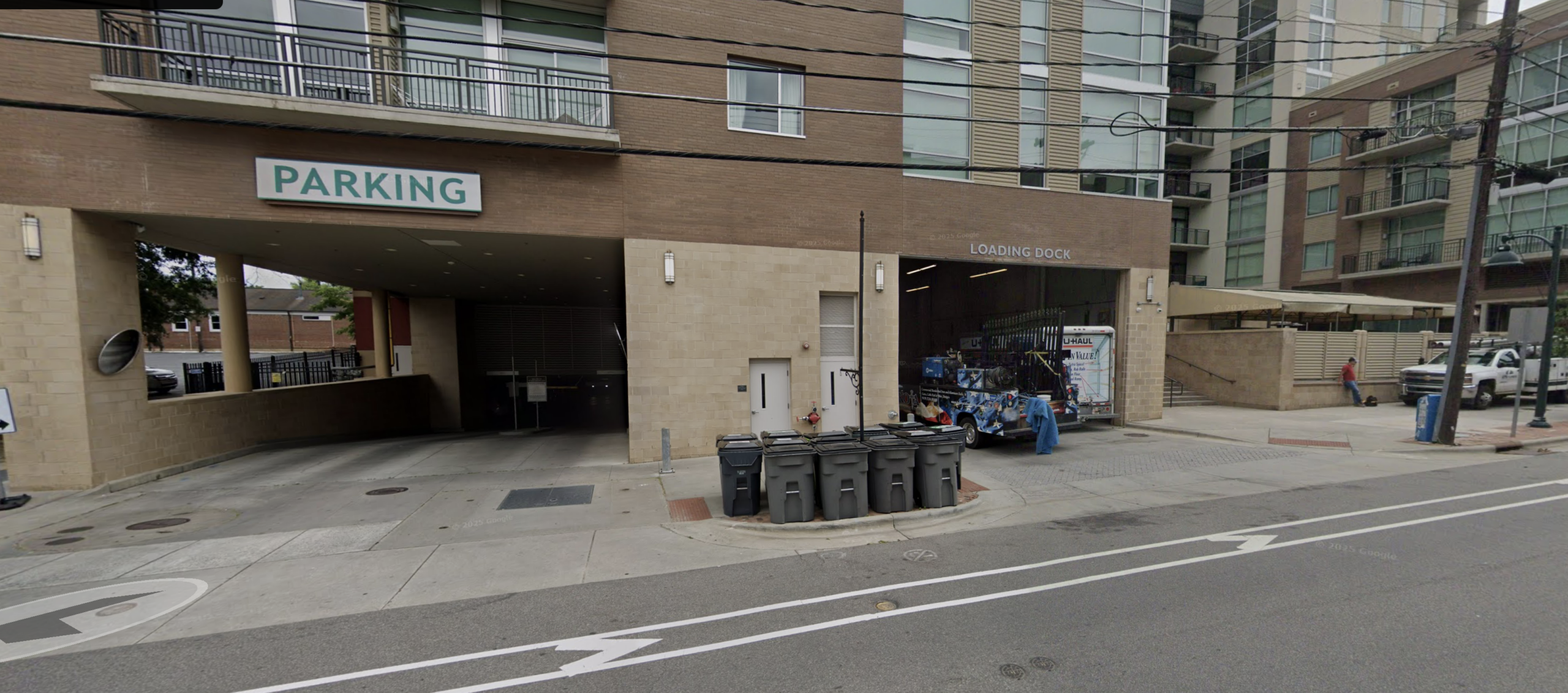
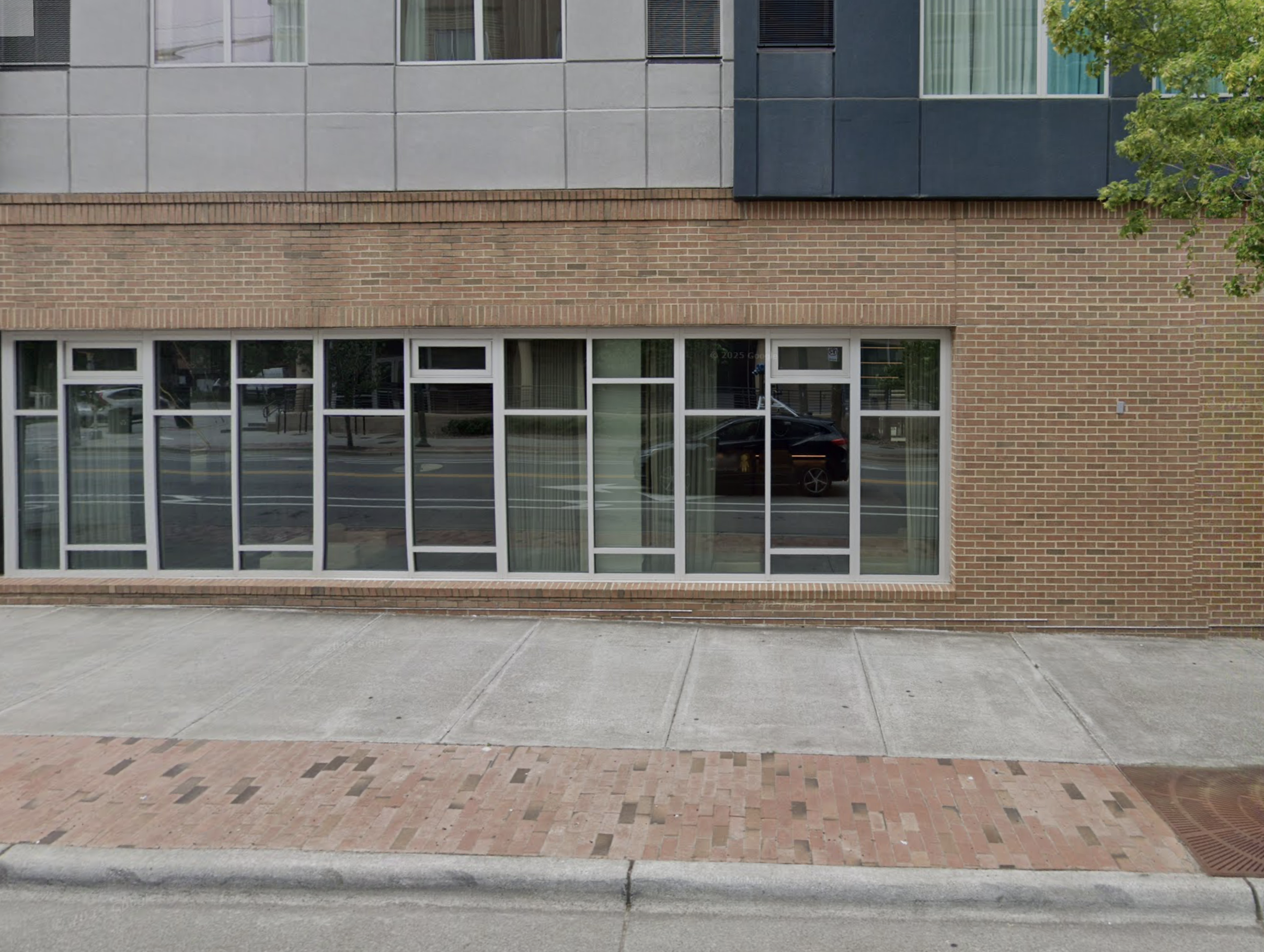
Paris Miller-Foushee expressed concern about Rosemary Street having the “butt” of the building, meaning that Franklin Street gets nicer aesthetics and pedestrian experience, Rosemary gets the less desirable elements like a service alley for trash trucks and entrances and exits to a parking garage. She’s right to be concerned, as Chapel Hill has a bad and intentional history of favoring Franklin Street over Rosemary (despite Franklin being a state controlled road, while Rosemary is town controlled, meaning the town could more easily impact the look and feel of Rosemary through pedestrians and streetscape improvements there). East Rosemary is dominated by two hulking, soul destroying parking garages, while newer developments on West Rosemary like 140 West and the AC Hotel effectively turn their backs on the street, creating streetscapes bland enough to make lifelong smokers give up the habit because it’s too depressing to take smoke breaks there. These are cautionary cases the developer would be wise to avoid recreating (friendly tip if they are reading: the summer sun will be brutal for hours on end on Rosemary. Ask anyone ever forced to sit out front at Open Eye or the former 401 Main. Start planning now for things like trellises and planters and climbing vines if you want any chance of customers lingering out front of the retail spaces – whatever street trees the town requires you to install will NOT cut it).
Camille Berry inquired about impact to the Bicycle Chain’s parking lot next door to the proposed development. Due to limited space, its customers currently park in angled spots, then exit by driving around the Fifth Third bank. After redevelopment, the bike shop will gain enough space for perpendicular parking, allowing customers to enter and exit from the same spot.
Mayor Anderson asked how the retail spaces can be not only affordable but also attract entrepreneurs from Northside or other disinvested neighborhoods. The developer supports the idea, noting that he’s met several times with Delores Bailey, executive director of EMPOWERment Inc., and would be open to a process that prioritizes Northside businesses. But that regardless of where the tenants come from, a goal will be to ensure the affordable retail spaces create a sense of vitality, such as by committing to remaining open on weekends or into evening hours.
Amy Ryan appreciated the affordable retail component, the potential to bring food trucks into the pedestrian alley, and the developer’s commitment to placemaking. She encouraged them to investigate Carolina Square as a cautionary tale of a public outdoor space that does not work well and emphasizes the importance of ensuring shaded areas.
Melissa McCullough praised the proposed development, saying it offered more benefits than the previously approved wet lab. And offered a vision for what it means to have such a project downtown:
If we can make places like this where the adults can live, we can get empty nesters out of homes that will be freed up for families. We can make it so that new couples, postdocs, medical residents, and people like that can stay in Chapel Hill after they graduate, which would be really nice because that would increase the people here who love Chapel Hill and who increase the vibrancy. It’s going to be a huge increase in tax base and business stimulation over the parking lots that are there now.
What’s next?
With zoning approval, the developer can begin shifting from what is now a concept to more concrete plans. The devil is always in the details with these things. We generally know about how big the building will be but the exact design, numbers of units, and price points is still to be determined. It could all fall apart if the financing doesn’t come together. It could be a beautiful building, like Phil Szostak is building at 1100 Columbia, or hideous, like that one newish apartment building near Trader Joe’s that looks like the developers sourced materials from locals selling scrap brick and lumber on Craigslist (it’s so ugly google won’t even return search results so I can name it – it’s on the right as you head to Durham on 15-501). And that’s ok! Such are the risks that come with living in an urban environment. Cities are supposed to change – that’s why we invented them.
The developer says they aim to break ground by the third quarter of 2027.
On the same night the town council approved a new land use management ordinance, it was refreshing to see that same spirit applied to this project. I have no particular love or hate for what this developer is proposing (ok, I do love the affordable retail piece), but I am thrilled to see approval of homes for perhaps 300-400 new neighbors without months of wailing and gnashing of teeth or death by a thousand cuts to the building’s design. Kudos to council on getting shit done.