
On Thursday, March 12, the Chapel Hill Carrboro City Schools Board of Education advanced a plan to consider closing one or more of three elementary schools—Ephesus Elementary, Seawell Elementary, and Glenwood. The Board directed staff to consider many factors in deciding which schools to close, and, starting last week, Dr. Rodney Trice has hosted a series of public conversations on the matter.
Although CHCCS is not planning to close any schools until August 2027, the decision will be made this spring. While there are good arguments for and against closing any of the three schools, at this stage the most important question is whether the Board will close one school or two. While closing any school is a momentous decision, closing two could permanently change the trajectory of the district in a way that might be difficult to return from.
This is why I asked for the CHCCS Board and staff to consider current and future housing growth in their plans. Other districts across the country are also making school closure decisions without fully accounting for housing growth to their detriment. Thankfully, the Board has requested that Carolina Demography update the demographic projections they provided last fall, and revise them to include the effects of current housing development on future student population. We hope that their report includes enough detail for the Board to make an informed decision. Here are three things I hope the Board keeps in mind as they make their decision.
1. Orange County agrees that Chapel Hill Is building a lot of housing
It is fortuitous that Orange County Board of County Commissioners, who set funding levels for CHCCS and, thus, are effectively the ones responsible for determining whether the Board needs to close one school or two, are also thinking about the future growth of the county. In 2024, the BOCC began work on the 2050 Orange County Land Use Plan, a process that, among other things, will shape how much land we will use for housing in our county, as opposed to the hobby farms that dot the “Rural Buffer” or even the industrial sites that line the interstate.
On March 10, the BOCC held a work session where they heard updated information on the county’s housing production. As they learned, there are 3,850 homes currently under construction in the county, most of which are in Chapel Hill and Hillsborough, including 3,189 apartments, 413 townhomes, and 248 single-family homes. There are additional 7,515 units that are approved, but not yet under construction, including 4,995 apartments, 1,213 townhomes, and 1,307 single-family homes.
To put this in context, according to the 2020 Census there were approximately 61,000 homes in Orange County (For geography nerds, parts of Chapel Hill and Mebane are in different counties, which makes it hard to pin down the exact number of homes in the Chapel Hill and Mebane parts of Orange County. We confirmed with Orange County planning staff that their housing estimates include Chapel Hill homes that are being built in Durham County. Although we didn’t ask, this number may include the Alamance County parts of Mebane as well.) Here’s what this looks like in chart form:
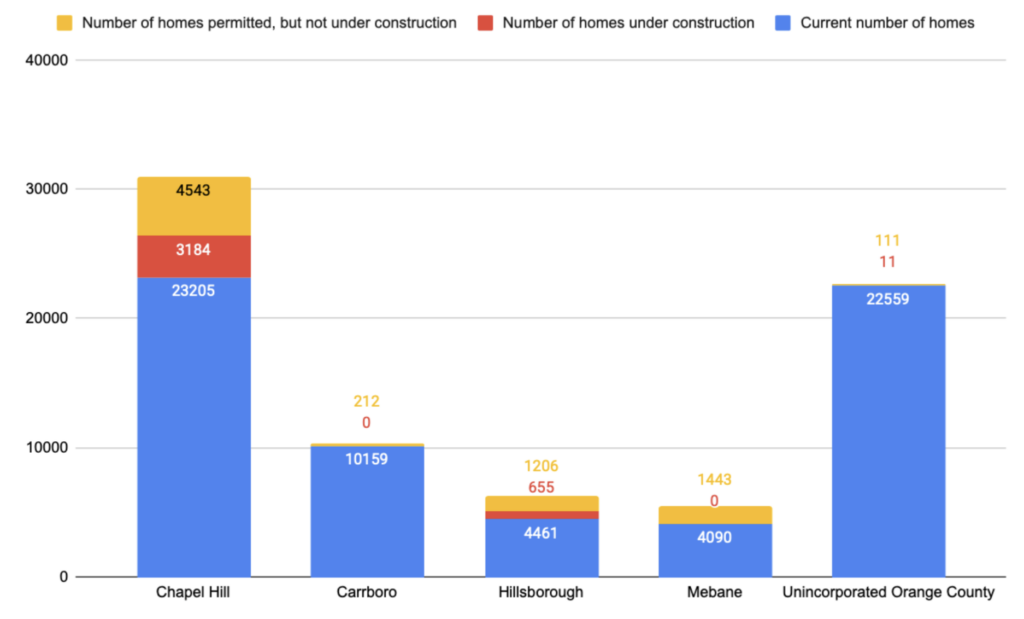
This means that we are essentially building the equivalent of a Carrboro, which has 20,000 people, in the next decade. (You might notice that Carrboro, which has control over a lot of empty land, is far behind other towns in the county in terms of building new housing. They should do something about that!)
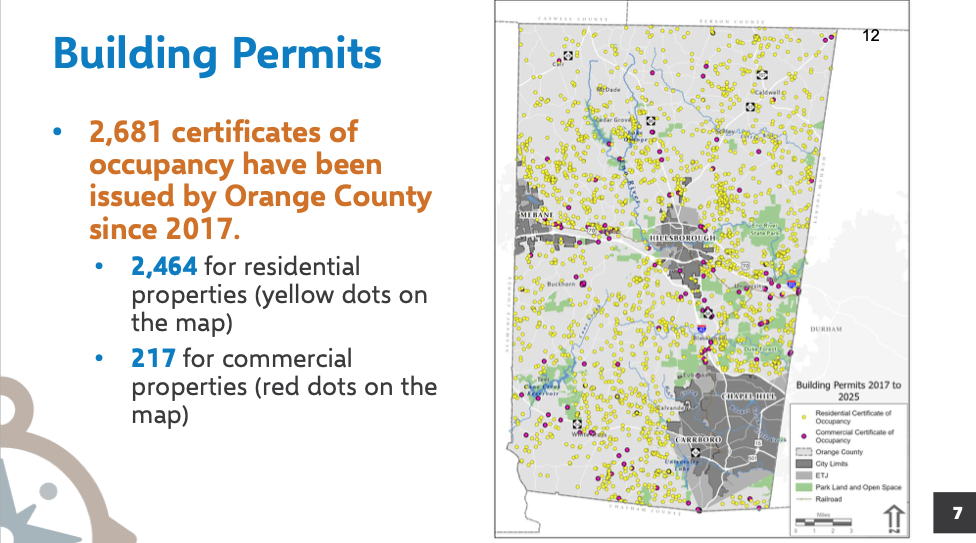
The county also confirmed that all this new housing will be a shift in Orange County’s trajectory. We’ve only built 2,681 homes since 2017, which means we’re scheduled to build as many homes in the next two years as we did in the previous nine.
2. Determining the relationship between housing growth and increases in the K-12 population is tough.
In the decade (2010-2020) where Chapel Hill built very little housing, Orange County saw slow population growth, relative to our region, a sharp rise in the number of senior citizens, and the early signs of a decline in our school-age population. What little housing Chapel Hill did build in this period was housing either intended for senior citizens (like Azalea Estates, built in 2020) or college students (like Shortbread Lofts, built in 2014).
If you assume these growth patterns continue, things do look very dire for the school system. But, new housing typically changes expectations for growth, including the number of school-aged children. Each year, Orange County produces an update on student enrollment projections under the Schools Adequate Public Facilities Ordinance, or SAPFO.
The SAPFO annual report provides two types of enrollment prediction for the CHCCS district. First, it uses recent historical data to project enrollment trends for the coming 10 year period. This projection is similar to the preliminary data shown shown by Carolina Demography at the CHCCS fall retreat in that it considers historical enrollment trends to make a prediction of future enrollment. According to the 2025 SAPFO Annual Report, current enrollment trends used in isolation would suggest that the number of students in the CHCCS district will continue to decline. Even though the projected decline in this trend has slowed relative to recent years, the decline does persist if your only input is historical trends.
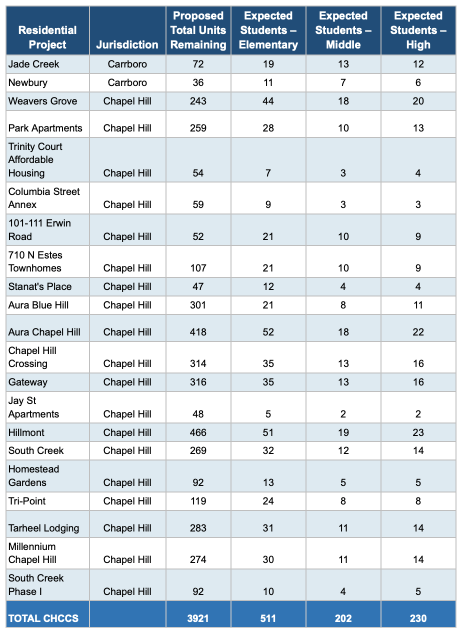
But the past is not always the best guide to the future, so the SAPFO report also provides an estimate of the number of students who might enter the district because of housing units that are in the short term development pipeline. And with this development there is the potential for a large influx of students to the district in the near term. In the key demographic of elementary school students, the district might expect 511 students to be added to the rosters because of the construction of 3,921 new homes.
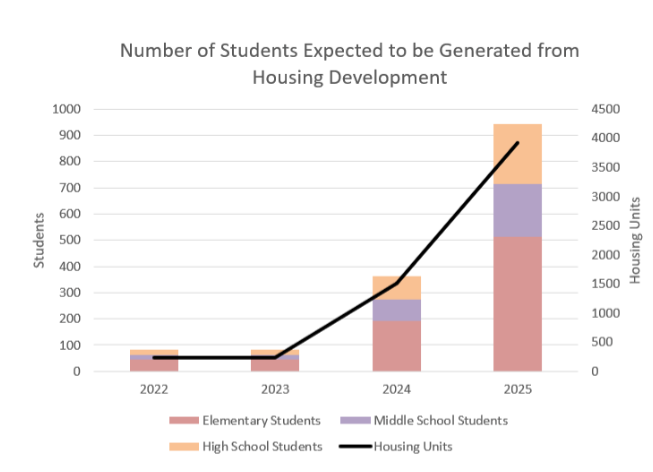
In recent years, the demographic estimates, based on historical trends, have started to diverge from estimates based on housing growth. As recently as 2022, the SAPFO report was showing just 44 elementary students and 82 total students arising from 235 predicted new housing units. We’ve seen a ten-fold increase in the amount of housing that’s being built in our community, and a similar rise in expected student growth.
It’s important to note here that the methodologies the County used does not fully account for the “moving chains” effect (or, if you prefer, the “musical chairs” effect). Many of the neighborhoods near UNC’s campus are full of single-family homes that have been turned into student rentals, in part because previous Chapel Hill Town Councils were reluctant to approve new housing downtown. New housing should help reverse that trend.
3. Our “capture” of regional housing growth, and K-12 students in particular, is important
In 2023, the Chapel Hill Town Council received a report on future planning. Although the report was focused on planning related to the North-South Bus Rapid Transit project (which is currently being held up by the Trump administration, but will in all likelihood be built in the next decade), the study also considered how Chapel Hill might change its slow-growth trajectory. One important observation was that Chapel Hill’s “regional capture” of new housing, and population growth, was on the decline in the 2010s.
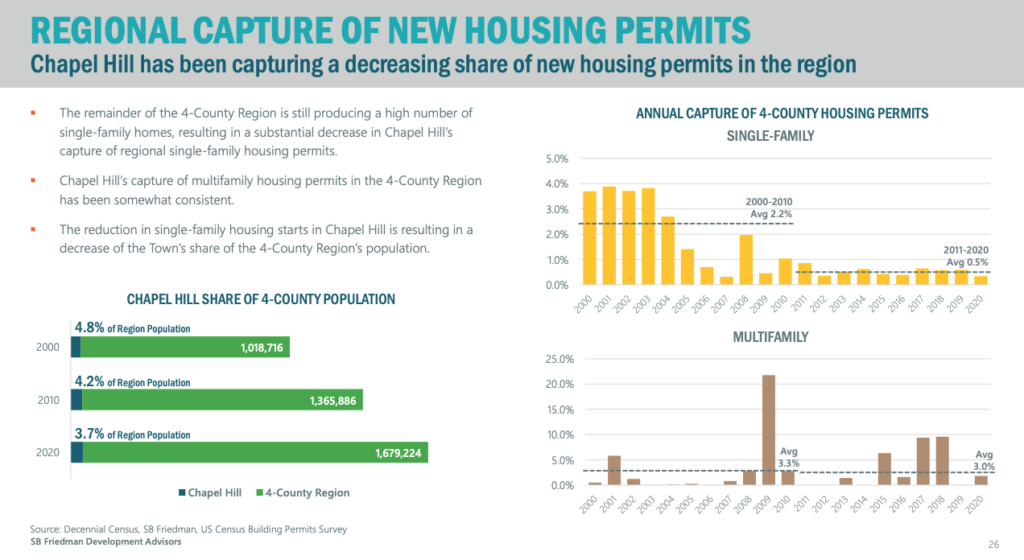
Chapel Hill is a desirable place to live for many reasons, and, importantly, it’s a major employment center, so much so that tens of thousands people come into our community each day to work. By thinking about Chapel Hill in a regional context, it becomes clearer that this notion of “regional capture” can apply to many contexts, including our schools. Nationally, the number of school-age children is shrinking. There are many causes for this, which are beyond the scope of this article, but what’s important for our purposes is that the Triangle is still expected to see an increase in the number of school-aged children between now and 2040.
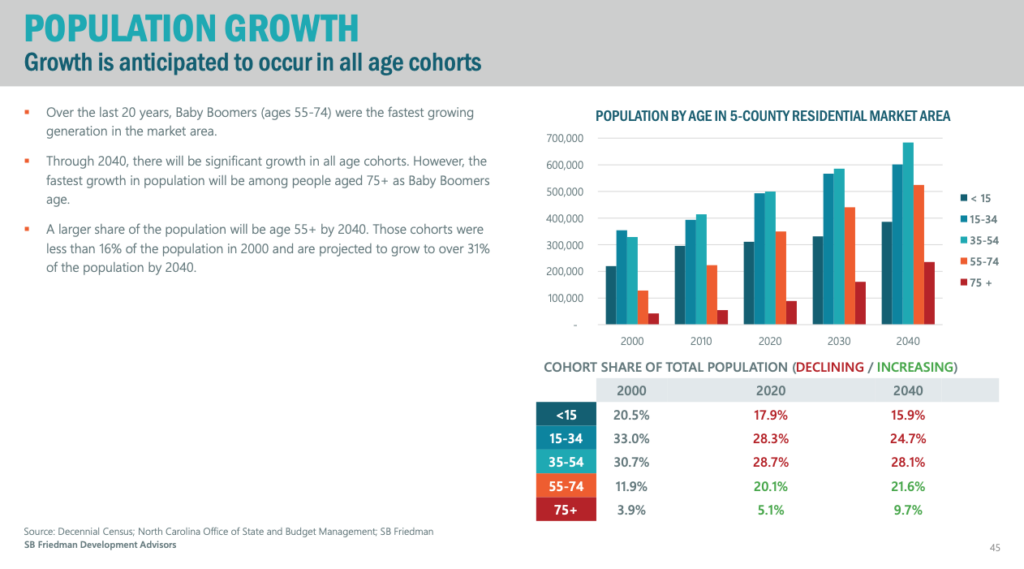
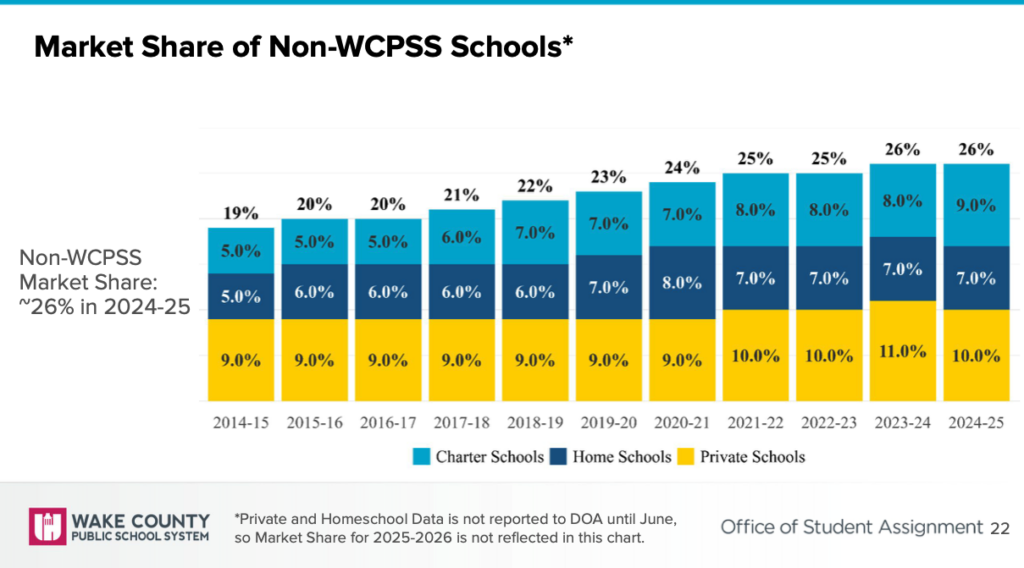
Neighboring counties are also losing a lot of K-12 students to homeschooling, charter schools, and private schools. Wake County estimates that one in four school-age students are choosing private, charter, or homeschool options instead of public schools. I don’t know if CHCCS publishes similar data, but it would be helpful if they did, and if our district explored strategies, like offering universal pre-K, to attract students.
But, if CHCCS is losing school-aged population in large part because housing costs are high, as I suspect, then it seems reasonable to expect that if our community becomes a more affordable place to live—which it will as we add more housing—we will see some people choose to live here, rather than Chatham, Durham, or Wake. The question before our community, and CHCCS, is whether our community is primarily interested in sustaining, and even increasing, our school-age population, or whether we want to become a smaller district. This is a policy choice, to some degree, not only something that’s determined for us.
Building the already approved homes in Chapel Hill and approving more housing in Carrboro will go a long way to ensuring that our school enrollments will stabilize or grow, rather than continuing to fall. So far, the CHCCS School Board has received the most attention in this debate, as they are responsible for determining which schools to close. But the Orange County Board of County Commissioners can help support our schools by doing the following:
- Consider the long-term implications of closing two schools versus one. Building a new school is a multi-year process. The planning process for the new Carrboro Elementary, set to open in 2028, began in 2021, when the BOCC formed a capital needs working group to study school needs. Given Chapel Hill’s projected growth rate, closing two schools could leave us in a place a few years from now where we are having to quickly reopen a school, one that might need extensive investment due to maintenance neglect, thus costing CHCCS, and the county, more than it would have to just leave a school building open. In addition, closing one school, rather than two, leaves CHCCS with more flexibility in case bond funds are not sufficient to pay for three new schools. While CHCCS Board will decide on this question of closing one school or two, input from the BOCC will be critical.
- Work with CHCCS to develop affordable housing on empty school sites.In a few years, the school system will have at least one building site (the current location of Frank Porter Graham) and possibly more that would be suitable for housing. Although CHCCS staff is advising the Board to retain ownership of the sites, it would be possible to build affordable housing on these sites while saving space for school expansion down the road. In Wake County, non-profits worked togetherto build affordable housing, a YMCA, and a school on a single piece of land. Affordable housing is supportive of families with children, which means that using publicly owned land in this way will be especially beneficial to the district. When the new Carrboro Elementary building is finished, the site of the old school would also be well suited for affordable housing, preferably housing for teachers who are looking to save money while working for the district.
- Use county-owned land to build as much housing as possible. Recently, the San Diego Unified School District decided to take a novel approach to building housing on school-owned land. Rather than focus only on projects that were affordable to very low-income individuals, which required significant government subsidy, they decided to instead emphasize those that produced the most amount of housing, while remaining affordable to the middle-income families they sought to serve. This meant a large increase in the amount of housing they are expected to build, which will benefit everyone. The BOCC has for decades left large tracts of county owned or co-owned land (like the Greene Tractand land near Morris Grove Elementary) undeveloped while they decide what to do, rather than acting quickly to support our community.
- Align the CHCCS school district boundaries with town boundaries. At present, there are large amounts of land that lies within the Chapel Hill-Carrboro City School district, but outside the control of either Chapel Hill or Carrboro. Given our need for more housing, particularly townhouses, aligning these districts will make it easier to add housing throughout our community. For example, it doesn’t make sense for parts of the rural buffer to line Interstate 40. We should build more housing there instead.
- Consider raising the CHCCS district tax. As Chapel Hill town council member Theodore Nollert noted in his Substack post this weekend, our school’s challenges are downstream of a state legislature that is pumping hundreds of millions of dollars into subsidies for private schools, while starving our public schools of resources. Although raising our district tax is not an ideal response, it’s a tool that our county commissioners could use to help our schools weather this moment.
Please write the Orange County Board of County Commissioners and ask them to support CHCCS schools, and to pursue all available options to set our community on a better path going forward.
Chris Esposito contributed to this article.
Chris Esposito is a parent of two current and one future Ephesus Elementary School students. He is a coastal wetlands scientist based in Chapel Hill.