An effort by Town Council members to shrink the size of the body and extend the mayor’s term from two to four years came to a skidding halt Wednesday evening.
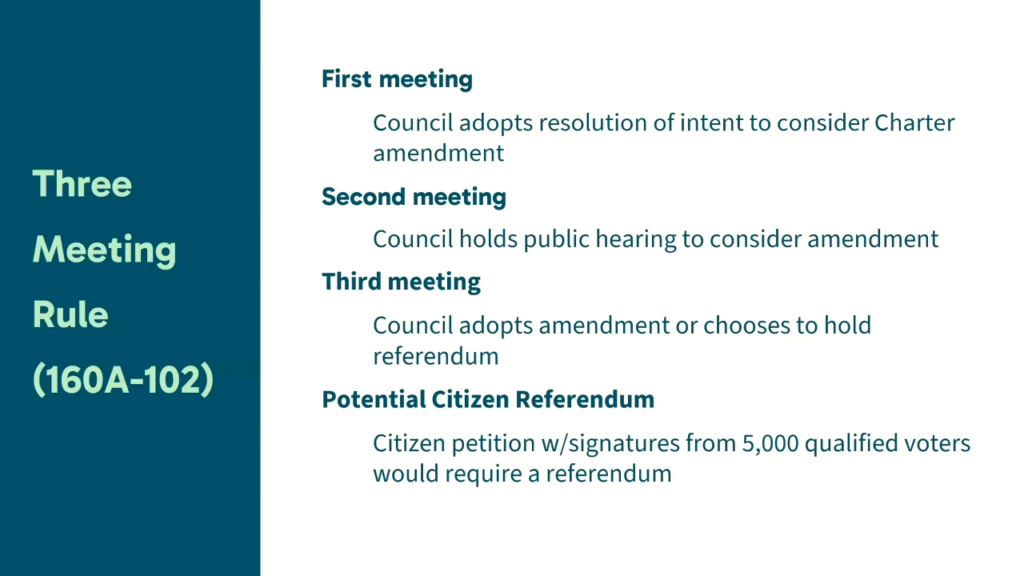
The idea of reducing the size of Town Council from eight to six members was first raised in early 2020 after council member Rachel Schaevitz resigned, leaving the council with only seven members. (Her seat was not filled until the November 2021 election). While that effort was put on hold due to the COVID pandemic, it was resuscitated this year under a new council and first brought to light at the April 15, 2026 council meeting, when council approved a “resolution of intent” to consider making the change—the first step in the process to change the town’s charter.
The public hearing at the April 29 meeting was the next step in the process, and all eight public speakers sharply criticized the proposal, most ignoring the three-minute time limit as they denounced the town’s lack of communication, its failure to consider the impact on groups within the community, and the lack of a clearly articulated reason for shrinking the council.
Criticism came from across the political spectrum. Former Chapel Hill mayor and current Orange County clerk of court Mark Kleinschmidt, who lost his 2015 reelection campaign thanks largely to CHALT-led opposition, was joined by Nancy Oates, who was elected to Town Council in 2015 as part of a CHALT-backed slate, in opposing the proposal.
Following the opposition at the public hearing, Town Council decided not to move forward with plans to adjust council size or the mayor’s terms in 2026. The mayor and council members apologized for the lack of outreach and admitted there was need for further engagement and discussion on the merits of the proposals.
During the public hearing, residents focused on the rationale for the 1975 increase in the size of the council from six to eight and the proposal’s failure to grapple with reversing that change. Kleinschmidt noted discussions with former African-American council member Bill Thorp who explained why the fourth council seat in every cycle was important, who told Kleinschmidt that “the only way we could actually get black voices on the council was to be able to consolidate our votes, and whenever we made it four each cycle instead of just three each cycle it meant we didn’t have to get as many—because to come in fourth, you don’t need as high a percentage of the vote that you would need if you were coming in third.” Kleinschdmit noted that the change allowed for these voices that were otherwise not heard to be present at the table. “And it didn’t just impact the ability of African-Americans to get onto this council, but it opened the door for lots of diversity,” pointing out college students and other minorities who have won election to the fourth seat.
Betty Curry pointed out that the decision to expand the council came during the the leadership of Howard Lee, the first African American elected as mayor in a majority-white city, and that it ocurred “because communities like Northside and Pine Oaks demanded representation. It was a response to exclusion. Now today, we are being asked to reduce that representation without demonstrating that those inequities have been resolved. They have not.”
Danita Mason-Hogans predicted that the proposal would consolidate power in the town. “Reducing the size of council may sound administratively efficient, but it would also consolidate power. It would raise the threshold for those who can win and benefit incumbents, established networks, better funded campaigns, and people who are already legible to Chapel Hill’s dominant political culture,” she said. “When there’s a large pool of candidates and only one or two candidates are from marginalized communities, those communities often have to consolidate their votes around very limited choices. So a third or fourth place finish does not necessarily prove that Chapel Hill is broadly welcoming. It might prove that marginalized communities have fewer options to begin with. So we’re talking about this town and a country where the consequences of uneven representation are not theoretical,” pointing to the large generational wealth gap in Orange County and achievement gap in Chapel Hill-Carrboro City Schools.
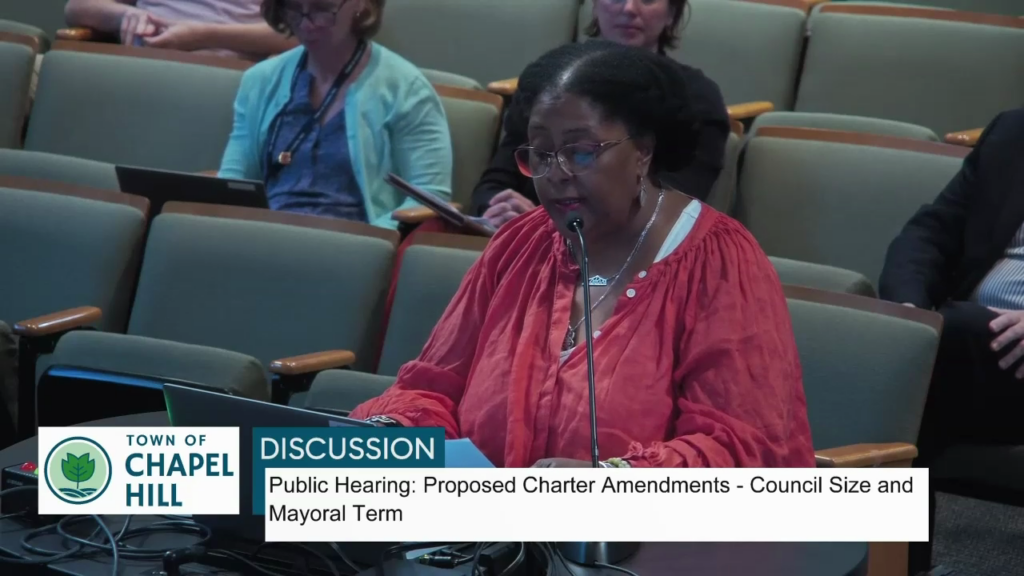
Others, including Dolores Bailey, criticized the lack of community engagement in the development of the proposal—which Town Council could have adopted without a referendum, unless a community-led petition effort garnered adequate signatures within 30 days. Curry noted that “we are being asked to accept a major structural change, reducing council seats, extending mayor’s terms. These are not minor adjustments. These are decisions that shift power, assets, and representation in Chapel Hill. And yet, where was the community in this process? Where was the outreach to the black communities, Latino communities, low-income resident renters, very people most impacted by decisions made in this room? Because of where we stand, that engagement did not happen.”
Speakers pushed back on the claim that a four-year term for mayor was needed to reduce the burden of constant campaigning for the seat and allow the mayor to implement their own vision. Bailey noted that “public office should remain accessible to working people and if the structure is already demanding, we should look at ways to better support officials not insulating them from voters for longer periods.” She said that two-year terms help “ensure regular accountability, keep leadership closely connected to the community, and maintain a more accessible pathway to participation in local government.” Oates pointed out that in a weak-mayor system like Chapel Hill’s, where day-to-day governance is run by a town manager and the mayor’s powers are generally limited to setting the council agendas, the mayor’s vision is not nearly as relevant. Kleinschmidt pointed out the risk of unbalanced elections, with the mayor’s race potentially attracting much higher voter turnout than the off-cycle elections where only four council seats were on the ballot.
Following public comment, council members apologized for the lack of public outreach—council member Amy Ryan noted the need to make sure there are opportunities for community members to become involved in town governance and establish feasible routes to gain political power. Others connoted to support the concept of adjusting the size of the council and the mayor’s term. Council member Elizabeth Sharp suggested that a four-year mayoral term would allow mayors to make “sound, clear decisions with the public interest” without being consumed by immediate thoughts of their own political future. Council member Louise Rivers III suggested that an extended term for the mayor would allow for greater balance in the town’s dealings with the University of North Carolina. Mayor Jess Anderson shared her experience that two years is not enough time to take on the role of the mayor and building the relationships both inside and outside of town hall to be most effective. She also noted that most town and city councils have fewer members than Chapel Hill’s, and that it was important for Chapel Hill to learn if that would make the council more efficient.